
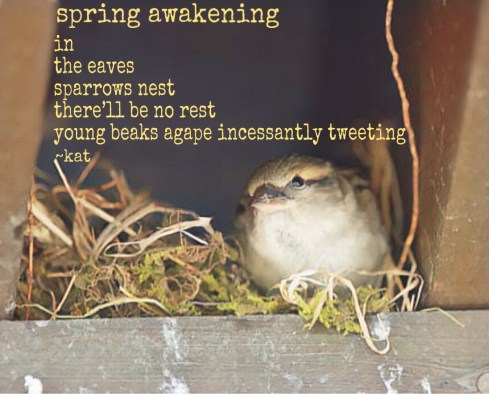
spring awakening
in
the eaves
sparrows nest
there’ll be no rest
young beaks agape incessantly tweeting
~kat
Poetry form for the month of May: Tetractys/5 lines/syllable count 1-2-3-4-10
spring awakening
in
the eaves
sparrows nest
there’ll be no rest
young beaks agape incessantly tweeting
~kat
Poetry form for the month of May: Tetractys/5 lines/syllable count 1-2-3-4-10
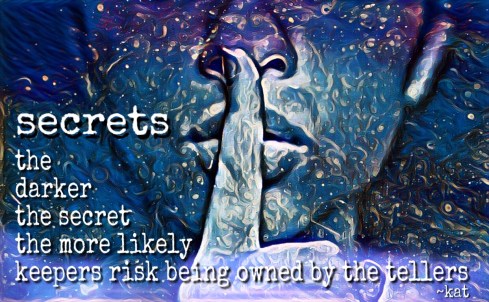
secrets
the
darker
the secret
the more likely
keepers risk being owned by the tellers
~kat
Poetry form for the month of May: Tetractys/5 lines/syllable count 1-2-3-4-10

hard labor
when
we work
to survive
it costs our soul
if that is our only motivation
~kat
Poetry form for the month of May: Tetractys/5 lines/syllable count 1-2-3-4-10
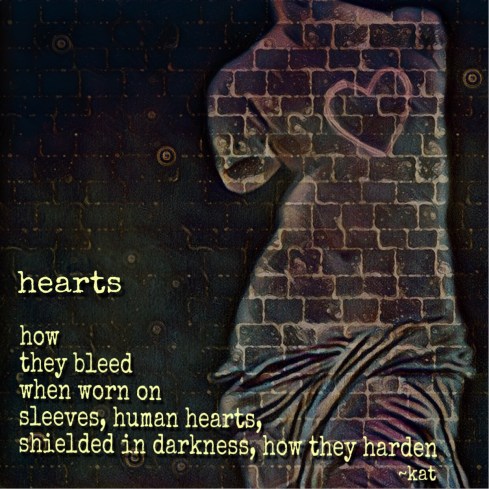
hearts
how
they bleed
when worn on
sleeves, broken hearts,
shielded in darkness, how they harden
~kat
This month we’re exploring the Tetractys, a poetic form invented by Ray Stebbing, consisting of at least 5 lines of 1, 2, 3, 4, 10 syllables (total of 20). Tetractys can be written with more than one verse, but must follow suit with an inverted syllable count. Tetractys can also bereversed and written 10, 4, 3, 2, 1.
Double Tetractys: 1, 2, 3, 4, 10, 10, 4, 3, 2, 1
Triple Tetractys: 1, 2, 3, 4, 10, 10, 4, 3, 2, 1, 1, 2, 3, 4, 10
and so on.
“Euclid, the mathematician of classical times, considered the number series 1, 2, 3, 4 to have mystical significance because its sum is 10, so he dignified it with a name of its own – Tetractys. The tetractys could be Britain’s answer to the haiku. Its challenge is to express a complete thought, profound or comic, witty or wise, within the narrow compass of twenty syllables.” – Ray Stebbin
Missed posting this Monday. A Blackout Poem inspired by Elizabeth Bishop’s poem, “Poem”.
useless relic
it must be
a wisp, a hint
barely there
a breath…
how strange
it is, the
memory of
a memory,
dim in detail
yet to be
dismantled
~kat
Poem
by Elizabeth Bishop
About the size of an old-style dollar bill,
American or Canadian,
mostly the same whites, gray greens, and steel grays
-this little painting (a sketch for a larger one?)
has never earned any money in its life.
Useless and free., it has spent seventy years
as a minor family relic handed along collaterally to owners
who looked at it sometimes, or didn’t bother to.
It must be Nova Scotia; only there
does one see abled wooden houses
painted that awful shade of brown.
The other houses, the bits that show, are white.
Elm trees., low hills, a thin church steeple
-that gray-blue wisp-or is it? In the foreground
a water meadow with some tiny cows,
two brushstrokes each, but confidently cows;
two minuscule white geese in the blue water,
back-to-back,, feeding, and a slanting stick.
Up closer, a wild iris, white and yellow,
fresh-squiggled from the tube.
The air is fresh and cold; cold early spring
clear as gray glass; a half inch of blue sky
below the steel-gray storm clouds.
(They were the artist’s specialty.)
A specklike bird is flying to the left.
Or is it a flyspeck looking like a bird?
Heavens, I recognize the place, I know it!
It’s behind-I can almost remember the farmer’s name.
His barn backed on that meadow. There it is,
titanium white, one dab. The hint of steeple,
filaments of brush-hairs, barely there,
must be the Presbyterian church.
Would that be Miss Gillespie’s house?
Those particular geese and cows
are naturally before my time.
A sketch done in an hour, “in one breath,”
once taken from a trunk and handed over.
Would you like this? I’ll Probably never
have room to hang these things again.
Your Uncle George, no, mine, my Uncle George,
he’d be your great-uncle, left them all with Mother
when he went back to England.
You know, he was quite famous, an R.A….
I never knew him. We both knew this place,
apparently, this literal small backwater,
looked at it long enough to memorize it,
our years apart. How strange. And it’s still loved,
or its memory is (it must have changed a lot).
Our visions coincided-“visions” is
too serious a word-our looks, two looks:
art “copying from life” and life itself,
life and the memory of it so compressed
they’ve turned into each other. Which is which?
Life and the memory of it cramped,
dim, on a piece of Bristol board,
dim, but how live, how touching in detail
-the little that we get for free,
the little of our earthly trust. Not much.
About the size of our abidance
along with theirs: the munching cows,
the iris, crisp and shivering, the water
still standing from spring freshets,
the yet-to-be-dismantled elms, the geese.




 like mercury colliding...