
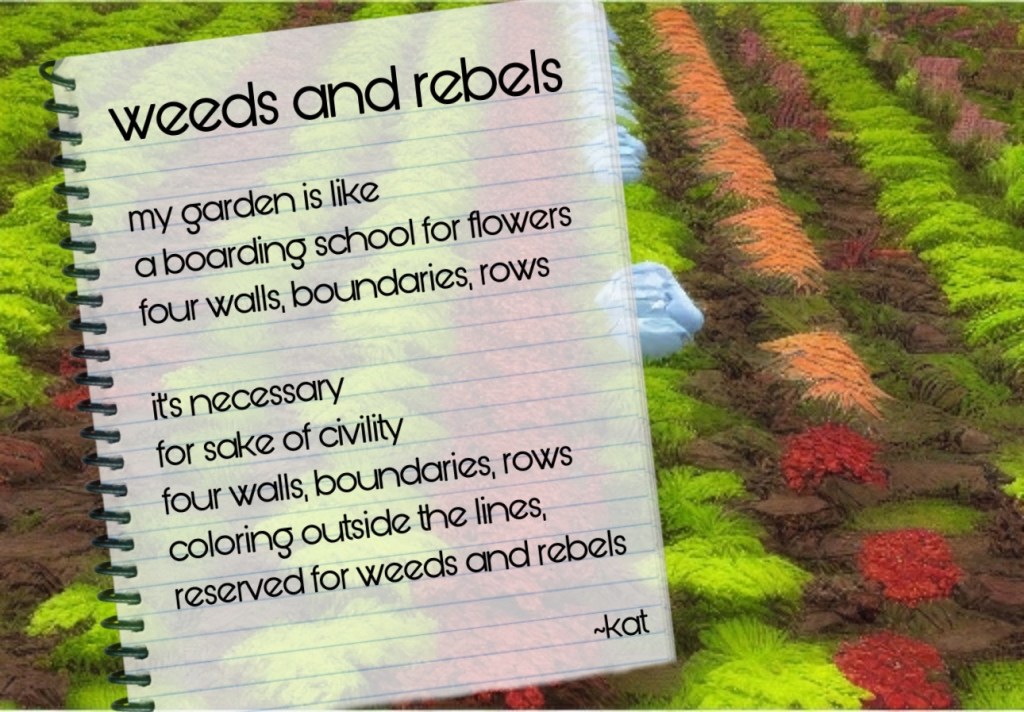
weeds and rebels

my garden is like
a boarding school for flowers
four walls, boundaries, rows

it’s necessary
for sake of civility
four walls, boundaries, rows
coloring outside the lines,
reserved for weeds and rebels

~kat
The Hainka
The 17-syllable haiku is the shortest form of poetry, and the 31-syllable tanka is probably the second shortest format of verse. Precisely the new form of poetry, hainka, is an assimilation of objective sensitivity of haiku with the more subjective oriented of tanka poetry. The synthesis in hainka is based on the image linking (the ‘fragment’ of haiku acting as the ‘pivot line’ of the following tanka) to explore and interweave human nature, love, emotion, humor in a broader sense by juxtaposition of the imageries.
It is also interesting to see the syllabic coherency between the ‘fragment’ (5-syllable words) with the 5-syllable words of the ‘pivot line’ of tanka. The final structural configuration would be 5/7/5/5/7/5/7/7 (s/l/s/s/l/s/l/l) with the significance of the image linking. A breathing gap (swinging space) is preferred between the haiku and tanka for the reader to imagine and experience the essence of poetry.
This image-linking across time and space is the art of painting an integrated poetic expression and exhibiting the fervent elucidation of hainka writing. Moreover, it retains its focus on the beauty of genetic image-linking to explore the poetic spell within the broader structural framework of the aesthetic essence and rhythms of Japanese short forms of poetry. Echoing the spirit of Basho’s ‘atarashimi’ (newness), I wish that the new verse will entwine the art of gratitude encompassing nature, living beings, non-living beings, and humanity as a whole.
Read more about the evolution of this form at Poetry Digest here: https://www.writersdigest.com/write-better-poetry/hainka-haiku-tanka-new-genre-of-poetic-form





 like mercury colliding...
June 8th, 2023 at 8:27 am
You’ve created a lovely picture of your garden
LikeLiked by 1 person
June 8th, 2023 at 9:15 am
Haha! As you know I am fond of a variety of flowering weeds!!! 😄
LikeLiked by 1 person
June 8th, 2023 at 10:27 am
😉😉😉
LikeLike
February 2nd, 2025 at 12:33 am
Dear Kat,
I am delighted to read all your beautiful Hainka poems. They embody the poetic spirit with resonance. I created the form long ago. The main essay is archived in the digital library, The Haiku Foundation.
Warm regards
Pravat
LikeLiked by 1 person
February 2nd, 2025 at 7:10 am
Dear Pravat,
Thank you! I am honored to meet the creator of this wonderful poetic form. Thank you as well for introducing me to The Haiku Foundation. I found your article and enjoyed learning more about the Hainka and you.
Sincerely,
Kat
LikeLike