Tag Archives: word of the day

Enfant Terrible – Friday’s Word of the Day

fullsizeoutput_20c8.jpeg

Friday’s Word of the Day ay dictionary.com is enfant terrible. (Think French accent when you say it…”ahn-fahn te-ree-bluh”). It is defined as an outrageously outspoken or bold person who says and does indiscreet or irresponsible things; an incorrigible child, as one whose behavior is embarrassing.

As for the origin of this word, In  French enfant terrible means “terrible child,” one whose language and behavior are embarrassing to adults. From the beginning of the appearance of enfant terrible in English in the mid-19th century, the phrase has also referred to adults who embarrass or compromise their party or faction by outrageous speech or behavior, especially artists or other creative people notorious for their unconventional lifestyle.

As its definition states, enfant terrible is a French word that literally, translated means ‘terrible child’. While it may have originally been used to describe actual incorrigible children, it is more often used these days to describe unconventional adults, particularly artists and designers in the fashion industry whose eccentric lifestyles and actions are forgiven for the fact that there is an undercurrent of genius displayed in their creations. And then, there are politicians…

I know what you’re thinking. You are probably surprised that I did not immediately apply this word to our current E.T. in Chief. It is tempting and all too easy. I did try to avoid the obvious in order to explore the nuances of this interesting, albeit timely word. But since my enfant terrible brain keeps bringing it up, I’m not completely sure that genius is a part of the makeup of political enfant terribles. It is quite possible there are other factors in play such as greed, lust for power, privilege, narcissism that drive their enfant terrible behavior…less forgivable for the resulting chaos they create…but I digress. And I’m a day late. Admittedly, I was rapt in the yesterday’s news of a roomful of enfant terribles who voted to shut the government down. A fitting one-year anniversary gift for our E.T. in Chief.

At any rate here are three Haiku to make up for my naughtiness.

enfant terribles
need an audience to shock
captive to torture

tell it like it is…
find an enfant terrible
if you want the truth

big baby
enfant terrible
narcissist

kat


Silver-Tongued – Friday’s Word of the Day

Today’s Word of the Day is silver-tongued. Oh dictionary.com you make this too easy! To be silver-tongued means to speak persuasively; eloquently: a silver-tongued orator.

It’s origin according to dictionary.com:

Silver-tongued may be named for the pleasing resonance of a silver bell. Even more pleasing and eloquent, therefore, would be chrysostom or chrysostomos “golden-mouthed,” from Greek chrysόstomos, from chrysόs “gold” and stόma “mouth.” As an epithet, chrysostom is reserved for the ancient Greek philosopher and historian Dio (or Dion) Chrysostom (c40–c115 a.d.), but in particular for the Greek patriarch and Church Father John Chrysostom (c347–407). On the first page of Ulysses, the unreliable, malevolent narrator refers to Buck Mulligan, who has gold fillings in his teeth and a very bawdy wit, as chrysostomos. Silver-tongued entered English in the late 16th century.

The art of eloquent speech is in short supply these days. We communicate in so many ways that are anything but silver-tongued. We have short attention spans that beg to be titillated by tweets, 60 second sound bites, text speak, ads that must grab our attention in the first three seconds, slang and abbreviated grunts!

But thankfully, beautiful words are not completely gone. In fact, when we hear a silver-tongued speech we rush to listen, inspired. ‘President Oprah’ had a very nice ring to it this week, even if only for a few days.

Notice, I did not refer to our current prez. He is what might be described as a silver-tongued devil (someone who, through flattery and slick speech, seeks to deceive others for their own gain.) Thanks to “45” we had a sad reality check this week. He reminded us why a majority of us didn’t vote for him, while reinforcing for the umpteenth time that he really is a racist, misogynistic, nationalist who is in the White House for his own self-aggrandizement. And all this while dragging us through the cesspool of his depraved mind adding another nasty word to our list of ‘not presidential’ diatribes, derogatory remarks and name-calling! Ugh! We are so fucked. (I considered toning that last word down but I am afraid another nicer word just won’t cut it…nope, fucked is the only way to say it…😳) Did I mention I didn’t vote for this guy? I didn’t vote for this guy.

But I digress, and I am sorry for that. Digressing is the last thing any of us should be doing. We need to hold fast to our love of beautiful words. We need to think them and write them and speak them. We need to speak to each other, face to face with the kindness and dignity due every human being.

I believe in the power of words. I believe in their beautiful ability to transform, uplift and affirm. And I’m rooting for the silver-tongued angels among us to win this war of words.

So I’ll close with a Lune, which is a short Haiku with the form 5/3/5. Sometimes brevity is the way to go!

let us strive to be
silver-tongued
angels not devils

~kat


Turncoat – Friday’s Word of the Day

turncoat

Today’s timely word of the day from Dictionary.com is Turncoat. A turncoat is “a person who changes to the opposite party or faction, reverses principles, etc.; renegade.” I do believe we have witnessed a recent surge of turncoats. It’s been entertaining to say the least.

According to Dictionary.com: There are several possibilities for the origin of turncoat. One is that two English barons in
the early 13th century changed fealty to King John (c1167-1216), literally changing their coats of arms from one lord to another. Another is that during the siege of Corfe Castle (1645) during the English Civil Wars (1642-51), Oliver Cromwell’s soldiers turned their coats inside out to match the colors of the Royalist army. A similar expression “to wear the King’s coat”, dating from the mid-19th century, means “serve in the King’s army”. The now obsolete idiom “to be in someone else’s coat” dating from the mid-16th century, meant the modern “to be in someone else’s shoes”. Turncoat entered English in the 16th century. 

Wikipedia provided a nice list of turncoat events. It is interesting to note that being a turncoat is not necessarily seen as a bad thing, which distinguishes a turncoat from being a traitor. The following lists a few circumstances that would be considered the actions of a “turncoat”:

  • In groups, often driven by one or more leaders, such as a mass shift by a population taking place during a military occupation, revolution, social upheaval, etc .
  • When the goal that formerly motivated and benefited the person becomes (or is perceived as having become) either no longer feasible or too costly even if success is achieved.

And as mentioned, here are a few notable events that fit that description:

  • The English Civil War during the 17th century. The siege of Corfe Castle was won by Oliver Cromwell’s soldiers when they turned their coats inside out to match the colours of the Royal army.
  • During the revolution of the British American colonies when U.S. Continental Army Major General Benedict Arnold defected to the side of the British in May 1779.
  • Canada during the War of 1812. Some Canadians felt republican democracy was a better system of government than the British Monarchy and fought on the side of the invading Americans. Conversely the United Empire Loyalists left what was to be the United States and moved North to remain under British rule.
  • Germany and Austria after World War II when many former enthusiastic members of the Nazi Party embraced the newly created nations of West Germany or East Germany and sought to erase or at least minimize their former role as Nazis. During the decades that followed many former Nazis regained prestige and held high posts in the new republics. Kurt Waldheim, an Austrian Nazi, even held the highest post at the UN for a while.
  • France after the downfall of the Vichy Regime, when many collaborationists, whether home-grown fascists or Nazi sympathizers, played down their role in the former government and its institutions.
  • Iran after the overthrow of the last Shah Mohammed Reza Pahlavi’s regime. At that time many persons who had formerly led a life based on secular and liberal values and who had fervently supported the Iranian monarchy suddenly embraced the stern religious values imposed by Ayatollah Khomeini’s regime with unbridled fervor.
  • Russia and the former Communist Eastern European countries after the fall of the USSR, where many former communists suddenly became fervent supporters of capitalism. As a result, many former apparatchiks abandoned the Communist Party in favor of positions in the new government structures.
  • In Spain after the Spanish Civil War(1936–1939), and again during the Spanish transition to democracy (1975 onwards).

It is also interesting to note that in the aftermath of the actions of a turncoat, there may be an attempt to rewrite history, burying the past by concealing evidence, or by whitewashing the deeds of the renegade’s activity.  Alternative facts, fake news, deep/dark states, loyalty pledges, gas lighting? My oh my, but this is a timely little word!  I chose to write an “Alphabet Haiku” for you. (Meaning each word starts with the same letter). Have a great weekend!

tick tock turncoats talk
trumping terrible tweets through
titillating truths

~kat


Bedizen – Friday’s Word of the Day

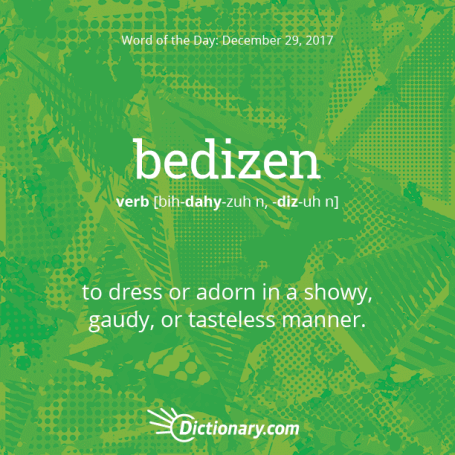
Today’s word of the day at Dictionary.com is Bedizen, which means ‘to dress or adorn in a showy, gaudy, or tasteless manner’.

According to Dictionary.com:

Bedizen is not a common verb in English. It is a derivative of the even more uncommon verb dizen, which occurs only from the 16th century and becomes obsolescent by the end of the 19th century. The element diz- is probably the same as in distaff “a staff for holding flax or wool for spinning” and is probably related to Middle Low German dise “bunch of flax on a staff for spinning.” Bedizen entered English in the 17th century.

I also learned that while the word bedizen is rarely used in conversation these days, it can be found in print. It has a flashy ring to it, don’t you think? Almost sounds like “bedazzled”. One site suggested that because it is an obscure word you can easily insult a highfalutin somebody! Being unfamiliar with its meaning they might even thank you for it!

To be clear, this is not a word meant to compliment someone. I don’t know about you, but I’m keeping this one in my tool chest for those special people in my life whose narcissistic, attention-seeking, haughty behavior gets under my skin…and I’m going to practice saying it with a wink and a smile…you’re welcome! 😀

Speaking of…

accustomed to glitz
they bedizened the White House
calling it a dump

~kat


Abubble – Friday’s Word of the Day

Today’s dictionary.com word of the day is ‘Abubble’. Now, first things first. This fine adjective is in the scrabble dictionary and will net you a respectable 13 base points in Scrabble and an even better 18 base points in Words With Friends. Though, I should point out that there are only two B’s in standard Scrabble and Words with Friends decks, so you’ll need a wild tile to pull it off. Bananagram, on the other hand, gives us three B’s to work with, because? Well I am guessing, ‘banana’ of course, but that’s just a guess.

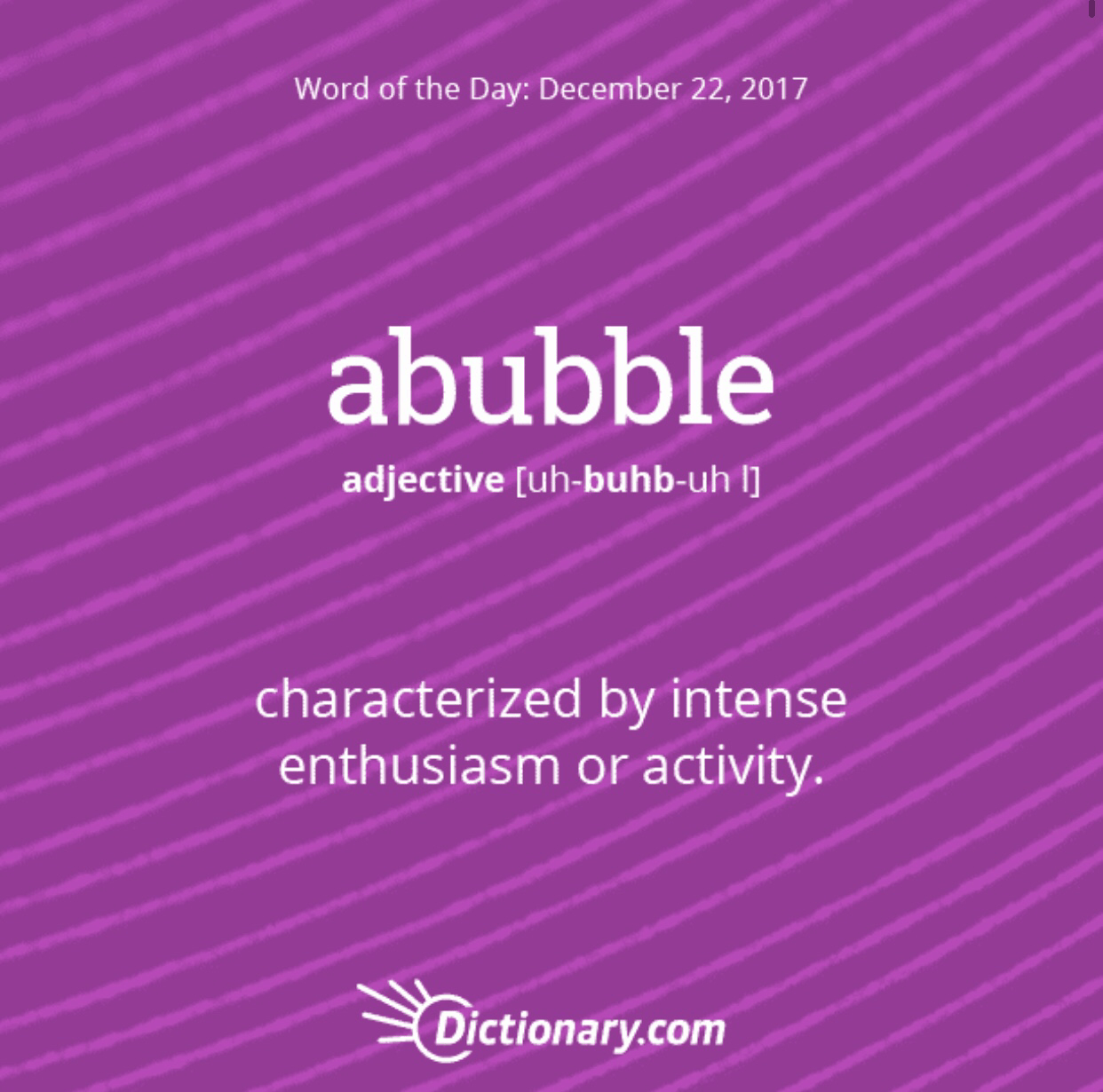
Abubble is defined as ’characterized by intense enthusiasm or activity: the store was abubble with last-minute shoppers’, and ‘bubbling, as while cooking or boiling’.

Dictionary.com also gives us an English language lesson in its description of the origin of abubble:

“There are English adjectives that, like abubble, can be used only in the predicate and not as attributives, such as aglow and asleep : one can say “The baby is asleep,” but not “the asleep baby.” These predicative adjectives are in origin noun phrases consisting of the preposition on governing a following noun, which also explains why predicate adjectives show no degree of comparison (e.g., asleeper, asleepest) and cannot be modified by adverbs (e.g., “The baby is extremely asleep”). Abubble entered English in the 18th century.”

I can tell you that my spellcheck does not like this word, instigating a me-said, spellcheck-said battle every time I try to type it. It’s most annoying, having to override a persistent A.I.Bot who thinks the ‘a’ should be separated from its “bubble”.

But that just won’t do for today’s word of the day. A bubble is a noun after all, but abubble is something quite different. Ultimately I win this battle of wit and words, though spellcheck is a sore loser and underlines my word in red to remind me that it’s not over. Oh no. Spellcheck will slip into autocorrect every chance it gets if I’m not on my p’s and q’s and abubble’s.

I will admit there is a certain satisfaction that comes with out-texting spellcheck. One might say that I am abubble over winning this battle when spellcheck finally puts away its red line and lets me have my way.

Anyhoo…(can you believe spellcheck didn’t tag anyhoo? I don’t think it’s speaking to me now…big baby!) I should close out with a Senryu or Haiku. (Oh, there you are Spellcheck, with your red line! You don’t like Senryu, eh? Well, I can assure you that a Senryu is a thing. It’s a Poetry form in the pattern of a Haiku 5-7-5. From Wikipedia: Senryu tend to be about human foibles while haiku tend to be about nature, and senryu are often cynical or darkly humorous while haiku are more serious. So there!)

the pols are abubble
as he wields his crayon
signing us to debt

~kat

Yep…uh-hmmm…this just happened. (My newsfeed just announced this headline on the top of my screen…”Trump Signs a Sweeping $1.5 Trillion Tax Bill into Law”.) We are so (fill in your favorite expletive here), and we, as in regular, working people, are most certainly not abubble one tiny bit…though it is also true that our tempers might just be! Grrrrr!

Have a lovely weekend!