Tag Archives: word of the day

Sepulcher – Friday’s Word of the Day

sepulcher

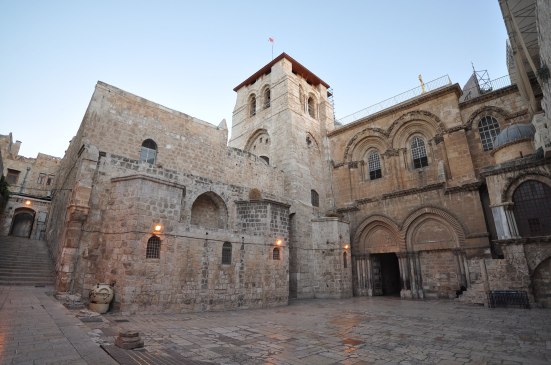
A timely word for today’s dictionary.com word of the day, sepulcher or sepulchre is notably associated with The Church of the Holy Sepulchre, (from Wikipedia) also called the Basilica of the Holy Sepulchre, or the Church of the Resurrection by Eastern Christians, a church within the Christian Quarter of the walled Old City of Jerusalem. It was first built in the second century AD by Roman Emperor Hadrian to honor the goddess, Venus. Notably, it is said to have been built directly over the cave where Jesus is said to have been buried. It wasn’t until the year 325/326 when Constantine ordered that it be torn down and a church erected in its place. Constantine’s mother, Helena is said to have discovered the tomb. A freestanding chapel was erected to House the tomb. Recently the tomb’s housing was renovated, unsettling and revealing was has remained enshrined for centuries.

Dictionary.com explains: Sepulcher comes via French from Latin sepulcrum “grave, tomb,” a derivative of the verb sepelīre “to perform the funeral rites, bury, inter.” The Latin verb comes from the Proto-Indo-European root sep- “to honor,” extended to sep-el- “sorrow, care, awe.” The same root appears in Sanskrit sapati “(he) worships, tends.”The Greek derivative of sep- is the root hep-, which usually occurs in compound verbs, e.g.,amphiépein “to look after, tend to,” as in the last line of the Iliad, “Thus they tended to (amphíepon) the funeral of horse-taming Hector.”Sepulcher entered English in the 13th century.
1920px-The_Church_of_the_Holy_Sepulchre-Jerusalem


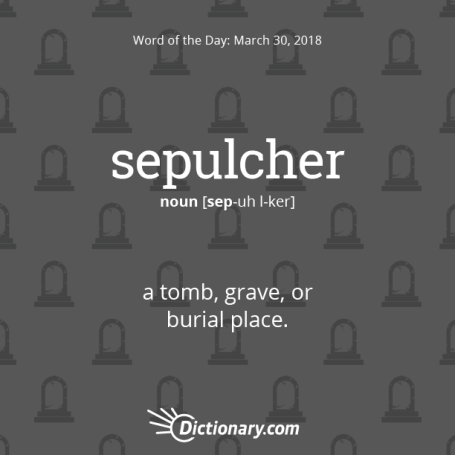
It is defined as a tomb, grave, or burial place; also called Easter sepulcher. Ecclesiastical (a cavity in a mensa for containing relics of martyrs; a structure or a recess in some old churches in which the Eucharist was deposited with due ceremonies on Good Friday and taken out at Easter in commemoration of Christ’s entombment and Resurrection); to place in a sepulcher; to bury the dead.

My google rambling revealed a few other uses for the word. A ‘whited sepulcher’ is described literally, as a whitewashed tomb, outwardly clean but continuing decaying corpses. One would call someone who is a ‘hypocrite’ a whited sepulcher.

There is also a legal term called “right if sepulcre”. It is a common law doctrine that human remains must be left undisturbed in their place of deposition. There is a gruesome case that invoked ‘right of sepulchre’ as it related to the remains of a young man killed in a car accident. An autopsy was prescribed and the coroner retained the young man’s brain in a jar for further evaluation after releasing the body to his family for burial. The family would have been none the wiser had the boy’s sister not discovered the jar, with her brother’s name prominently displayed, on a shelf, while she and her classmates were on a school field trip to the coroner’s office.

And finally, Marvel Comics introduced a superheroine named Sepulchre in its Quasar series in 1993. Also nicknamed “shadow-woman”, she was the alter ego of Jillian Marie Woods empowered with the ability to manipulate dark forces as a member of the Roxxon Energy Corporation Secret Defenders Shock Troop.

Sepulchre-Sepulcre-Defenders-Jillian-Woods-Marvel-Comics

Sepulcher is certainly an ancient word with relevance for this day, especially if you celebrate. Happy Easter Weekend to you if you do!

what secrets linger
in dark ancient sepulchers
for some light and life

~kat
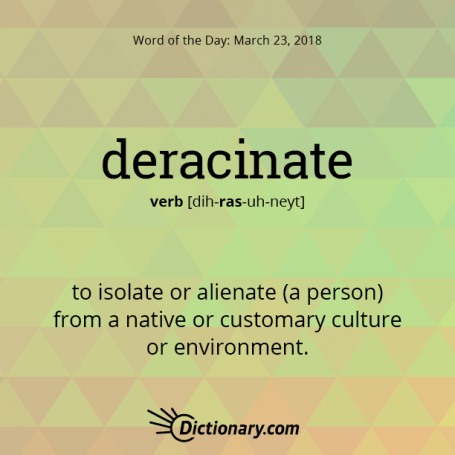

Deracinate – Friday’s Word of the Day

sizedimage

Today’s word of the day at dictionary.com deracinate is a new one for me even though I am very familiar with the concept of being deracinated.

Deracinated means: to pull up by the roots; uproot; extirpate; eradicate, to force (people) from their homeland to a new or foreign location, to isolate or alienate (a person) from a native or customary culture or environment, o liberate or be liberated from a culture or its norms.

It originated in the 1590’s from the French word, déraciner, “to pluck up by the roots”,  from Old French desraciner, “uproot, dig out, pull up by the root”, which which is linked to the Latin des- and racine, “root”, from the Late Latin, radicina, a diminutive of the Latin word, radix “root”.

Whether we’re talking about plants deracinated by the roots from the ground or people deracinated from their homeland, it is an unsettling word. Its very tone and tenor sounds harsh when I say it out loud. One can’t help but feel empathy for the deracinated. No one likes to be plucked from the roots and “liberated”, unless, of course, it is their idea in the first place. However we find ourselves plucked, there is a certain element of the unknown lurking in the shadows.

Even liberated, a synonym of deracinated, is a tricky word. I remember the first time I learned of a colleague’s firing. The management explained that “so and so” had been liberated from said company to pursue new opportunities. It almost made me feel hopeful and happy for my former co-worker. Liberated did not adequately describe the reality of the situation. No income, no benefits, unemployed. That does not sound liberating to me. but deracinated? Oh yeah…that’s the word for it. It’s a good word. An honest word. Deracinated is not a thing I’m eager to experience. It smacks of change after all, and who likes change? But it’ not necessarily a bad thing. Some people choose to deracinate themselves. And in that case, it is very liberating. At any rate, it is a word I am glad to know. For now, I’ve plopped it into a few haiku. Have a great Friday.

Deracinate

diversity’s extolled,
peace kept, deracinated
by don’t ask don’t tell

deracinated
by war and terrorism
they’ve no place called home

beautiful roses
deracinated from beds
wilt in sterile urns

expats are expert
at deracination to
assimilation

~kat


Bunglesome -Friday’s Word of the Day

Friday’s word of the day at dictionary.com is identified as an Americanism dating back to 1885-90. Bunglesome is characterized as or marked by bungling, clumsy, awkward, or incompetent. What really intrigued me about this word is the idea that it is considered an “Americanism”.

In case you are wondering, an Americanism is a word or phrase (or, less commonly, a feature of grammar, spelling, or pronunciation) that (supposedly) originated in the United States and/or is used primarily by Americans. Some accounts state that the term was first coined by the Reverend John Witherspoon, founding father and signer of the Declaration of Independence and president of what would become Princeton University.

Here’s are a few notable phrases and words: wigwam, pretzel, spook, depot and canyon, that borrowed from the Indians, Germans, Dutch, French and Spanish.”

Here is a list of Americanisms and their British English counterpart:

American English/British English
antenna/aerial
mad/angry
anyplace/anywhere
fall/autumn
bill/bank note
attorney/barrister, solicitor
cookie/biscuit
hood/bonnet
trunk/boot
suspenders/braces
janitor/caretaker

Read the entire list HERE.

So bunglesome is apparently an Americanism. In fact I also learned that you can add the suffix -some to a whole host of words. It makes the root word an adjective that implies more of the root word it is attaching to.

Well, I had best get to the Haiku. I’m already late, but bunglesome is too good a word to miss!

for bunglesome pols
appointed to a play a role
loyalty is key

~kat


Demonym – Friday’s Word of the Day

Today’s word of the Day on dictionary.com is demonym. It is defined as the name used for the people who live in particular country, state, or other locality: Two demonyms for the residents of Michigan are Michigander and Michiganian.”

Its origin from dictionary.com:
The name noun demonym is clearly from the Greek dêmos, “people, common people, common soldiers, (as opposed to officers) popular government, democracy, district, country, land.”. The second part of the word comes from Greek dialect (Doric, Aeolic) ónyma, a variant of ónoams “name” s very common in compounds like antonym and pseudonym. It entered English in the late 20th Century.

From Wikipedia:

National Geographic attributes the term “demonym” to Merriam-Webster editor Paul Dickson in a recent work from 1990.[10] The word did not appear for nouns, adjectives, and verbs derived from geographical names in the Merriam-Webster Collegiate Dictionary nor in prominent style manuals such as the Chicago Manual of Style. It was subsequently popularized in this sense in 1997 by Dickson in his book Labels for Locals.[11] However, in What Do You Call a Person From…? A Dictionary of Resident Names (the first edition of Labels for Locals)[12] Dickson attributed the term to George H. Scheetz, in his Names’ Names: A Descriptive and Prescriptive Onymicon (1988),[1] which is apparently where the term first appears. The term may have been fashioned after demonymic, which the Oxford English Dictionary defines as the name of an Atheniancitizen according to the deme to which the citizen belongs, with its first use traced to 1893.

I discovered that there official or common demonyms and then there are colloquial demonyms. For example, someone from the USA is officially an American or a Yankees or Yanks; Zimbabweans are also called Zimbos; the French are Frogs or Gauls; Faulkland Islanders are Belongers; Costa Rican’s are Ticos; and Canadians are Canucks. Here in the states we have Buckeyes (Ohioans), Ice Chippers (Alaskans), and Cheeseheads ( Wisconsinites). You can see a comprehensive list on Wikipedia, HERE.

There is an unspoken rule when crafting a demonym. If you’re stuck, go with what the locals call themselves.

Normally I do a Haiku but given the word of the day I am thinking only a limerick will do.

There once was a dude from the hood
Who lived life upstanding and good
Now he was no gangster
Say bro, he might answer
But demonyms fall short as they should

~kat


Phub – Friday’s Word of the Day

Today’s word of the day is phub. Dictionary.com defines phub as a slang word that means to ignore (a person or one’s surroundings) when in a social situation by busying oneself with a phone or other mobile device: hey, are you phubbing me?

Wiktionary tells us it’s a word that was created by combining the words phone and snub sometime between 2010-2014. But we’ve probably been phubbing for a bit longer, even though there was not a word for it yet. Phub, they explain, was coined by Adrian Mills at the McCann advertising agency as part of a campaign to promote the Macquarie Dictionary by creating a new word.

Have you been phubbed? It’s certainly a thing. We are attached to our phones these days, what with tweets and posts and texts that bombard us on a minute by moment basis. And by game apps; those addictive,mindless diversions that divert our attention from everything around us into a strobing screen…just one more round…a win, at-long-last. I’m must come clean. I have probably been a phubber. I may not have intentionally phubbed anyone, but I’m most certain I have done it. Not that I can recount a clear example. It’s all a blur.

I think it’s a good practice to establish rules of etiquette in this age of pocket media devices by setting up situational “no mobile device zones”. For example meal times, forcing everyone around the table to engage in conversation. Remember conversation? You don’t? When I finish this post I’ll send you a text link to Wikipedia so you can learn about it. 🤪 better yet, here’s the link…CONVERSATION. Sorry…didn’t mean to shout at you. 😊

you know, we should talk
true friends don’t let friends flubber
texting is for bots

~kat