Tag Archives: word of the day haiku challenge

Hobbyhorse – Friday’s Word of the Day


When I think of a hobbyhorse I imagine a stick with a horse’s head or a rocking horse, ridden by children, which is, in fact the second definition for today’s word of the day on dictionary.com. The first definition, a pet idea or project is not something I ever associated with the word hobbyhorse. 

A look at the word’s origin tells a different story. According to etymology online the word hobby actually means a “small, active horse,” from hobi short for hobyn (mid-14c.; late 13c. in Anglo-Latin), and was probably originally a proper name for a horse that is now extinct. Hobby as a shortening of hobbyhorse also was used in the “morris horse” sense (1760), or as Dictionary.com states “in the 16th century hobbyhorse meant several things, e.g., a figure of a horse made of wicker worn in morris dances, pantomimes, and burlesques; a child’s toy consisting of horse’s head on the end of a stick or a rocking horse; a horse on a merry-go-round or a carousel in the 1680’s. By the 17th century hobbyhorse developed the meaning “pet project, favorite pastime.” Hobbyhorse entered English in the 16th century.”

Is it just me or does the term hobbyhorse sound a bit redundant? Basically one is saying horse (hobby) horse. But I digress.
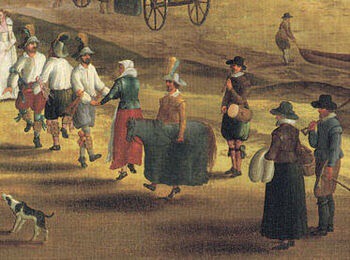
Painting of a hobby horse with Morris dancers beside the River Thames at Richmond, London, c.1620


Hobbyhorses were associated with May Day celebrations, Mummers plays and the aforementioned Morris dance in England in the 17th and 18th centuries. Wikipedia explains that there were several types of hobbyhorses:

*Tourney horses- meant to look like a person riding a small horse that is wearing a long cloth coat or caparison (as seen in medieval illustrations of jousting knights at a tourney or tournament)

* Sieve horses – a simpler version of the tourney horse. Known only in Lincolnshire, made from a farm sieve frame, with head and tail attached, suspended from the performer’s shoulders. The performer wears a horse blanket (the kind that includes a headpiece with holes for the eyes and ears) that covers them and the sieve.

* Mast horses – are meant to represent the horse (or other animal) itself. They had a head made of wood, or sometimes an actual horse’s skull was used; it usually has hinged jaws that can be made to snap. The head is attached to a stick about 1 m (3 ft) long. The person acting the creature is covered by a cloth attached to the back of its head; he (or, rarely, she) bends over forwards or crouches, holding the head in front of their own and resting the other end of the stick on the ground. A tail may be attached to the back of the cloth.

And this is only a sampling of the types of hobbyhorses used in Great Britain. In fact many countries and cultures have used a form of hobbyhorse in ceremonial dance, festivals, customs and theatre for centuries. You can read all about them at Wikipedia HERE.

So how did the word hobbyhorse become associated with an obsession? According to Wikipedia the term “hobby horse” came from the expression “to ride one’s hobby-horse”, meaning “to follow a favourite pastime”, and in turn, the modern sense of the term hobby. Makes perfect sense to me! 😉

Of course there is also the literary reference to the word penned by none other than the Bard himself, “Cal’st thou my love Hobbi-horse?” (Translation: A loose woman or strumpet) – William Shakespeare, Loves Labour’s Lost, in 1588. And there is the ‘velocipede’ (sounds like a very fast many-legged slug…the stuff of nightmares!)…also called a ‘pedestrian hobbyhorse’ or ‘dandy horse’. it was a two wheeled ‘bicycle’ that the rider propelled by pushing the ground with each foot alternately. This modern marvel, a forerunner to the modern pedaled version was all the rage in the early 19th century. It was featured in The Gentleman’s Magazine, February 1819.


So there you have it; a glimpse into today’s word of the day. And here’s a little Haiku to bring it all home…

this blogs a hobby
could say, it’s my hobbyhorse
my tack is a pen

~kat

Skylark – Friday’s Word of the Day Haiku

skylark

Today’s Dictionary.com word of the day is Skylark. I love, love, love today’s word. The Dictionary.com photo for today only shows the more recent definition of the word. The other definition refers to particular type of bird and I learned something wonderful and new today! I had no idea that skylarks are so named because of their unique quality of singing while flying and hovering high above the ground. Skylark the noun, which refers to this amazing bird, entered the English language in the late 1600’s. The verb version didn’t show up until two centuries later.

I have this recurring dream. In it I am always flying. It feels so real. I am swept up in the thrill of feeling my feet lift off the ground and ascent into the sky, higher and higher. Ironically, in my waking moments I have a debilitating fear of heights. My knees turn to jello and my head spins whenever I find myself in a high open place. But not in my dreams. In my dreams, I swoop and glide and take in the sights below…and I had not really thought about it before, but in my dreams, my heart sings.

When the burdens of life weigh me down I have this dream and am encouraged to rise above. When sorrow hangs like a dark cloud above me, I am encouraged to break through the clouds into the sunlight and beautiful cerulean blue sky, light as a feather, wind in my hair…and to let my heart and soul sing!

In my next life, I think I would like to be a skylark. Or perhaps my dreams are merely hinting at a previous incarnation to remind me that I have already learned to rise abover and to sing while flying!

Happy Friday to you! Have a wonderful weekend. Here’s my haiku!

Skylark Song

Next incarnation
oh let me be a skylark
flying high in song!

kat ~ 29 July 2016


Woolgathering – Friday’s Word of the Day Haiku

woolgathering

Have you been woolgathering lately?  Today’s Dictionary.com Word of the Day entered the English vocabulary in the 1500’s, literally meaning the gathering of the tufts of wool shed by sheep and caught on bushes. It is also associated with indulgence in idle fancies and in daydreaming and absentmindedness.

B.A. Phythian explains the connection between the word’s literal and figurative applications in A Concise Dictionary of Phrase and Fable (1993): It was an activity for poor people hoping to gather enough fragments to weave together, entailing a certain amount of haphazard rambling among hedgerows and fields by women and children. This rather random wandering has been a metaphor for dreaminess since the 16th century.

For additional understanding, here is Merriam-Webster’s definition:

Woolgathering once literally referred to the act of gathering loose tufts of wool that had gotten caught on bushes and fences as sheep passed by. Woolgatherers must have seemed to wander aimlessly, gaining little for their efforts, for in the mid-16th century “woolgathering” began to appear in figurative phrases such as “my wits (or my mind) went a-woolgathering” – in other words, “my mind went wandering aimlessly.” From there, it wasn’t long before the word woolgathering came to suggest the act of indulging in purposeless mind-wandering.

I don’t know that I have ever heard this word used, but most of us are not exposed to the literal activity of woolgathering in this day and age. Perhaps a better metaphor for 21st century woolgathering could be TwitterTrolling. Hmmm…I like it. “Her twittertrolling caused her to miss the boarding call for her flight.”

Woolgathering and twittertrolling, are considered indulgences in this modern era where time is money and we are constantly working to do more with less to satisfy some shareholder’s bottom line. If you do engage in occasional woolgathering it is a good idea to do so with one ear open and your wits intact so you don’t miss something important.

Here is my Haiku then…playing a bit with the sheep reference. Have a great Friday!

Those who are naive
minds adrift, woolgathering
are easily fleeced.

kat ~ 22 July 2016


Friday’s Word of the Day Haiku

selenotropism

Today’s Dictionary.com Word of the Day is Selenotropism. It’s a whopper of a word comprised of six syllables. This presents quite a challenge when tasked with writing a Haiku! I decided to use the adjective form giving me another syllable to work with and I also opted to take further creativity liberty in the application of the word. Selenotropism is a Biology term that refers to plant growth and movement in response to moonlight. The word entered English in the 1880’s and comes from the Greek “se”ēnē” for “moon” and trópos which means “turn”.

A bit about the biological term…

Most of us know that plants will lean toward light. If you place a plant in a window, you will find that you need to turn it every so often to keep it from leaning to one side. This phenomenon is called “heliotropism” (helio referring to the sun). A biologist by the name of M. Musset, intrigued by the  heliotropic movement of plants decided to conduct experiments on the influence of the reflected light of the moon. He chose three nights in February of 1883 to test his theory, exposing young plants to direct moonlight from 9 pm to 3 am. Almost immediately the buds of the plants bent the stalks in the direction of the moonlight and remained in a leaning position until the moon disappeared from view. He coined the term selenotropism, a nocturnal counterpart to the established heliotropism to name his discovery.

Source: Journal of the Royal Microscopical Society, Ser. II–Vol. III, 1883)

So now that you have a new bit of random information to log away in your brain, I am going to take this word on another twist. I propose that our dreams are inspired by the cool light of the moon. At least when I saw the Greek influence of the word, that is where my mind went…a “turning toward the Moon” and the way that moon glow influences our subconscious thoughts as we sleep. I suppose I’m taking full advantage of artistic liberty and freedom here, but then I am also prone to coloring outside of the lines too. Blame it on the moon!

To Dream Selentropic 

Adrift in sleepy
selenotropic currents
dreams flood the gray void.

kat ~ 8 July 2016


Olykoek – Friday’s Word of the Day Haiku

olykoek

Today’s Dictionary.com Word of the Day comes to us from the Dutch. It is “olykoek” which translated means, “oily cake” or “oil cookie”. Here in the US we would simply call one of these fried confections a donut. I would imagine this is today’s word because today is, in fact, National Donut Day here is the US.

According to Dictionary.com olykoek is an Americanism with roots in New York Dutch. It is formed on the basis of the Dutch oliekoek meaning “oilseed cake,” equivalent to olie, “oil” plus koek, “cake.”

Wikipedia offers additional insight into this word. Olykoek has gone through several evolutions trading popularity with a similar term oliebol or olybollen, translated “oily ball(s)”, depending on which dictionary one consulted at a particular point in history. In fact, “the 1868 edition of the Van Dale dictionary included the word obiebol, while its rival Woordenboek der Nederlansche taal didn’t include it until 1896, stating that the “oliekoek” is a more commonly used term.” And yet another shift occurred in the early twentieth century when oliebol once again became the popular term.

At any rate, olykoeks have been featured in fine art and literature, most notably, Washington Irving’s The Legend of Sleepy Hollow. It seems Ichabod was more enraptured with the sight of sweet Dutch pastries than he was of beautiful voluptuous maidens encountered in Van Tassel’s parlor! Here’s an excerpt:
“Fain would I pause to dwell upon the world of charms that burst upon the enraptured gaze of my hero, as he entered the state parlor of Van Tassel’s mansion. Not those of the bevy of buxom lasses with their luxurious display of red and white, but the ample charms of a genuine Dutch country tea-table in the sumptuous time of autumn. Such heaped up platters of cakes of various and almost indescribable kinds, known only to experienced Dutch housewives! There was the doughty doughnut, the tender oly koek, and the crisp and crumbling cruller, sweet cakes and short cakes, ginger cakes and honey cakes and the whole family of cakes.”  Such lovely words!!!

There is also a wonderful legend surrounding this origin of this word. From Wikipedia:
“They (oliebollen) are said to have been first eaten by Germanic tribes in the Netherlands during the Yule, the period between December 26 and January 6 where such baked goods were used. The Germanic goddess Perchta, together with evil spirits, would fly through the mid-winter sky. To appease these spirits, food was offered, much of which contained deep-fried dough. It was said Perchta would try to cut open the bellies of all she came across, but because of the fat in the oliebollen, her sword would slide off the body of whoever ate them.”

Quite an interesting word. As for me, I will likely stick to the familiar term for this pastry, the “donut” or as we say here in Virginia, another word synonymous with the olykoek…the irresistible “Crispy Kreme”!

Here are a few Haiku on the Olykoek:

The Olykoek Haiku

Dutch oily balls and cakes
Oliebollen…olykoeks
aka…donuts!

Lovely olykoeks
deep-fried dough doused in sugar
not just a donut!

When Yuletide is nigh
stuff yourselves with olykoeks
to outwit Perchta.

kat – 3 June 2016