Tag Archives: word of the day

Incogitant

Today’s Word of the Day at dictionary.com is incogitant. Not to be confused with incognizant or incognito, which google presented as possibilities. Incognitant is definitely a word, originating in the 17th century, though it does seem to be less popular than its cousins.

All three words have a common root, the Latin cōgitāre “to think” and the Latin negative prefix in-. it is when we add the suffix -ant “inclined to, tending to” that tweaks the meaning. Incogitant is defined as thoughtless; inconsiderate; not having the faculty of thought. While incognizant implies a sense of being unaware of something or unknowing, it is more in a passive or clueless sort of way, and incognito has to do with disguised identity, incogitant, with its tiny change in suffix -tant involves an element of willfulness. In fact, wiktionary simply defines incogitant as ignorant.

These days the streets are swarming with incogitant people. People who are not the least bit interested in knowing the truth, and worst of all, those who act on that ignorance to an extreme. Sound familiar? Maybe it’s just me. 🤔

Anyhoo…before I close this wordplay, I found one other reference while researching today’s word. A shout out to French philosopher and mathematician René Descartes’ (1596–1650) who coined the famous line, “cōgitō ergō sum” (“I think therefore I am”). Does that mean if I don’t think, I am not? Best to leave that one alone…along with the incogitant people of the world, unless of course, you engage them while incognito…just to be safe. My guess is they are incognizant that they are incogitant, precisely because they don’t care that they are either!

Here are a few Haiku then. Reminds me of another quote…”Never have a battle of wits with an unarmed person.” 😊 okay…I’m done now. Have a great weekend!

“Let them eat brioche!”
an incogitant retort
spoken from privilege

Covfefe…say what?
Incogitant tweet perhaps,
or sly like a fox?

~kat


Confabulate – Friday’s Word of the Day

confabulate.png

Today’s Word of the Day on Dictionary.com, Confabulate, is an interesting word for our times. Basically, it means to talk casually, converse or chat. It originated in 1610’s, from confabulatus,  past participle of Latin confabulari  “to converse together,” from com-  “together” (see com- ) + fabulari “to talk, chat, “from fabula “a tale” (see fable ).

It has a second meaning though, coined in psychological circles in 1924, that has found its way into our current dialog. Wikipedia offers a comprehensive look:

Confabulation is a disturbance of memory, defined as the production of fabricated, distorted, or misinterpreted memories about oneself or the world, without the conscious intention to deceive. Wikipedia goes on to explain, people who confabulate present incorrect memories ranging from “subtle alterations to bizarre fabrications”, and are generally very confident about their recollections, despite contradictory evidence.

There are several theories related to confabulation but one that caught my attention is the theory that proposes that confabulations represent a way for memory-disabled people to maintain their self-identity. And there are a host of disorders associated with frontal lobe injury or disease that present with some of the signs and symptoms associated with confabulation:

Signs and Symptoms of Confabulation:

  1. Typically verbal statements but can also be non-verbal gestures or actions.
  2. Can include autobiographical and non-personal information, such as historical facts, fairy-tales, or other aspects of semantic memory.
  3. The account can be fantastic or coherent.
  4. Both the premise and the details of the account can be false.
  5. The account is usually drawn from the patient’s memory of actual experiences, including past and current thoughts.
  6. The patient is unaware of the accounts’ distortions or inappropriateness, and is not concerned when errors are pointed out.
  7. There is no hidden motivation behind the account.
  8. The patient’s personality structure may play a role in his/her readiness to confabulate

Of course, there is a distinction between true confabulation and outright lies; that distinction being that the one confabulating truly believes the fabricated story they are telling, sometimes with such conviction that those listening may find themselves wondering if it is not indeed true. This can be problematic if the suffering individual’s illness is left unchecked, (thinking out loud here, confabulating if you will) especially if the individual confabulating is in a position of power or authority. I’ll let that settle with you for a few seconds.

It may be just me, but I am deeply concerned about the state of mind of our current chief executive. He seems to confabulate in waves, with lucid calculated, manipulating speech interspersed. Vulnerable, gullible people who are easily manipulated seem blind to the difference, believing his confabulations over verifiable fact. Believing I say, but what is most disturbing is their veneration of his statements because, they say, “he says what I think”. This realization is the scariest thought of all.

A few haiku for you then. Thanks for joining me for this confabulation on a most interesting word.

people watched aghast
poor confabulating fool
his mind sundowning

the truest old friends
confabulate for hours
words in unison

there is no solace
in confabulated yarns
that never happened

~kat


Nimbus – Friday’s Word of the Day Haibun/Haiku

nimbus.png

Today’s Word of the Day at Dictionary.com is Nimbus. Now, some of you may be familiar with its common link to a particular type of cloud formation; namely, Nimbostratus Clouds. They are those dark, low level clouds bursting at the seams with rain droplets, snow or sleet. I think they are my favorites because when they form the backdrop of a row of tall trees they transform the leaves into a luminous green.

First found recorded in the English language in 1730, Nimbus is linked to the Greek (nephos) “cloud” and Latin (nimbus and nebula), a meaning “cloud, mist”, and (nembh) “violent rainstorm, thundercloud”. The word, nimbus, is also linked to the Slavic (polish) word Niebo for “sky, heaven” which is probably why it was eventually applied to deities and gods. A nimbus in this application is defined at the bright cloud that envelops a deity appearing to mortals in classic mythology. In Christianity it refers to a saint’s halo or aureole.

If you’re a Trekkie, you will know that Nimbus III is located in the Neutral Zone in the Beta Quadrant in the Nimbus sector at the junction between the Federation, the Klingon Empire and the Romulan Star Empire. Or at least it was until they moved it to sit very near Romulus system, and far from the Klingon border. You can read more about that HERE.

These days we still use nimbus to describe a cloud, aura or the atmosphere around someone, if we even use it at all. According to the Collin’s Dictionary, nimbus is in the lower 50% of commonly used words. Nimbus is not a word that I’ll likely use.

Which brings me to the word nimble…which has nothing to do with nimbus. They’re not even closely related in etymological terms. But nimble is the new buzz word in business circles. Must be agile and nimble and identify synergies because at the end of the day, the bottom line means balancing our EBITDA to making our shareholders happy and richer at the end of each quarter. This is what happens when I’ve worked another long crazy week and it’s Friday and I have to come in on the weekend because other people didn’t do their work on time. GRRRRrrrrr!

But I digress. Breathe Kathy…let the nimbus of grace and peace surround you. Write a few Haiku. You’ll feel better…you know you will.  Ahhhh…ohhhmmmm…ahhhh…:)

Actually I do feel a bit better. Here are a few haiku for you. Hope you have a great weekend! 🙂

dull, entranced faces
aglow in pale blue nimbus
where’s the pokemon?

insanity looms
a suffocating nimbus
there is no normal

if you are there god
come out from the nimbus mist
we need a hero

when the sun is right
she appears as an angel
a nimbus of light

~kat


Hobbyhorse – Friday’s Word of the Day


When I think of a hobbyhorse I imagine a stick with a horse’s head or a rocking horse, ridden by children, which is, in fact the second definition for today’s word of the day on dictionary.com. The first definition, a pet idea or project is not something I ever associated with the word hobbyhorse. 

A look at the word’s origin tells a different story. According to etymology online the word hobby actually means a “small, active horse,” from hobi short for hobyn (mid-14c.; late 13c. in Anglo-Latin), and was probably originally a proper name for a horse that is now extinct. Hobby as a shortening of hobbyhorse also was used in the “morris horse” sense (1760), or as Dictionary.com states “in the 16th century hobbyhorse meant several things, e.g., a figure of a horse made of wicker worn in morris dances, pantomimes, and burlesques; a child’s toy consisting of horse’s head on the end of a stick or a rocking horse; a horse on a merry-go-round or a carousel in the 1680’s. By the 17th century hobbyhorse developed the meaning “pet project, favorite pastime.” Hobbyhorse entered English in the 16th century.”

Is it just me or does the term hobbyhorse sound a bit redundant? Basically one is saying horse (hobby) horse. But I digress.
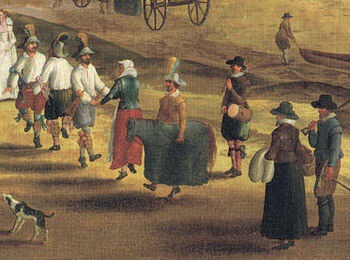
Painting of a hobby horse with Morris dancers beside the River Thames at Richmond, London, c.1620


Hobbyhorses were associated with May Day celebrations, Mummers plays and the aforementioned Morris dance in England in the 17th and 18th centuries. Wikipedia explains that there were several types of hobbyhorses:

*Tourney horses- meant to look like a person riding a small horse that is wearing a long cloth coat or caparison (as seen in medieval illustrations of jousting knights at a tourney or tournament)

* Sieve horses – a simpler version of the tourney horse. Known only in Lincolnshire, made from a farm sieve frame, with head and tail attached, suspended from the performer’s shoulders. The performer wears a horse blanket (the kind that includes a headpiece with holes for the eyes and ears) that covers them and the sieve.

* Mast horses – are meant to represent the horse (or other animal) itself. They had a head made of wood, or sometimes an actual horse’s skull was used; it usually has hinged jaws that can be made to snap. The head is attached to a stick about 1 m (3 ft) long. The person acting the creature is covered by a cloth attached to the back of its head; he (or, rarely, she) bends over forwards or crouches, holding the head in front of their own and resting the other end of the stick on the ground. A tail may be attached to the back of the cloth.

And this is only a sampling of the types of hobbyhorses used in Great Britain. In fact many countries and cultures have used a form of hobbyhorse in ceremonial dance, festivals, customs and theatre for centuries. You can read all about them at Wikipedia HERE.

So how did the word hobbyhorse become associated with an obsession? According to Wikipedia the term “hobby horse” came from the expression “to ride one’s hobby-horse”, meaning “to follow a favourite pastime”, and in turn, the modern sense of the term hobby. Makes perfect sense to me! 😉

Of course there is also the literary reference to the word penned by none other than the Bard himself, “Cal’st thou my love Hobbi-horse?” (Translation: A loose woman or strumpet) – William Shakespeare, Loves Labour’s Lost, in 1588. And there is the ‘velocipede’ (sounds like a very fast many-legged slug…the stuff of nightmares!)…also called a ‘pedestrian hobbyhorse’ or ‘dandy horse’. it was a two wheeled ‘bicycle’ that the rider propelled by pushing the ground with each foot alternately. This modern marvel, a forerunner to the modern pedaled version was all the rage in the early 19th century. It was featured in The Gentleman’s Magazine, February 1819.
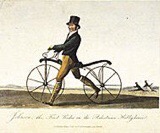

So there you have it; a glimpse into today’s word of the day. And here’s a little Haiku to bring it all home…

this blogs a hobby
could say, it’s my hobbyhorse
my tack is a pen

~kat


Ballon -Friday’s Word of the Day


Today’s word of the day at Dictionary.com is a French word: “ballon”. At first I wondered if it was a typo. “Shouldn’t that be ‘balloon’?” I thought. And then I looked at the definition and especially the origin of the word. It all began to make sense. From dictionary.com:

Origin of ballon
Ballon is a French term used especially in ballet, describing a dancer who appears to be floating in the air while executing a jump or other movement, like “His Airness,” Michael Jordan. Earlier English spellings of the word include balonne, baloune, and balloone as well as balloon. The original sense of the word in the early 17th century was “ball,” specifically a large, sturdy, inflated leather ball hit with the arms protected with wooden boards or kicked like a soccerball. By the late 17th century ballon and balloon had developed the meaning “a large globular glass vessel” used for chemical distillation; and by the late 18th century, balloon (thus spelled) also meant “a round, flexible, airtight bag that rises into the air when inflated with heated air or gas.” Balloon becomes the standard English spelling in the late 17th century. Ballon, as a ballet term, entered English in the 19th century.

So, ballon in ballet is about floating on air, and balloons? Well they are floaty orbs, unless they’re filled with water or made of glass. I got the impression that the original balloon was more about its shape than its floating qualities. And then I started to think of round, inflated ballerinas bursting at the seams of their leotards, tutus stretched tight and stiff around their middles, and I couldn’t help but giggle.

Which came first the ballon or the balloon? The latter, of course. Ballon, in ballet, entered the English vocabulary rather late to the dance in the 19th century. We humans had been filling animal bladders and other hollow bulbous things for centuries.

Somewhere between heaven and earth the idea of floating on air became associated with balloons and voila! We now have ballon to help us describe the amazing acrobatic, gravity-defying leaps of ballerinas. Being inflated and puffy not required!

I’m feeling silly today. I best give you my Haiku. Have a great weekend!

suspended, graceful,
the skilled ballon of dancers
defies gravity

~kat