Tag Archives: word of the day

Friday’s Word of the Day Haiku – Factotum

factotum

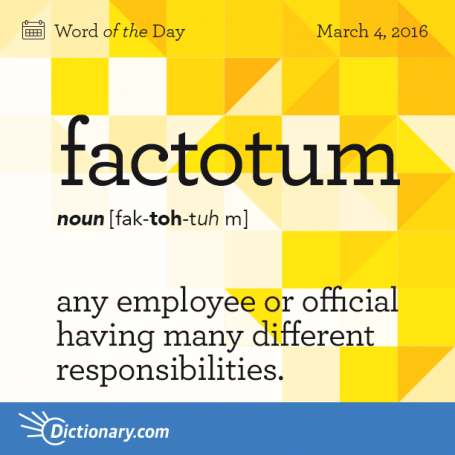
Happy Friday to you! Today’s Word of the Day from Dictionary.com is “Factotum.” The expanded definition is:

  1. any employee or official having many different responsibilities.
  2. a person, as a handyman or servant, employed to do all kinds of work around the house.
Origin of factotum
Factotum has roots in the Latin facere meaning “to make; do” and tōtus meaning “all.” It entered English in the mid-1500s.

Vocabulary.com offers a more expanded description:

“If you’re running late and still need to iron your clothes and make breakfast, but can’t find your shoes, you may wish you had a factotum, or a servant who does a variety of odd job for their employer.

Factotum sounds like the two words “fact” and “totem” spliced together, but this curious noun originally come from the Latin words that mean “do” and “everything.” In current times, since servants aren’t typical anymore, we might call someone who has a paid job like this a jack-of-all-trades or possibly a personal assistant.”

Having been a stay-at-home mom for a number of years as well as performing my current day job as an Executive Administrative Assistant, this is a word that really resonates with me. How have I not heard it before?

Well, it could have something to do with the fact that this is just another one of those historical words that doesn’t really apply in our modern culture…or does it? I can think of at least one application of this word that is true to it’s original meaning. I give you the modern “housewife”, “homemaker”, stay-at-home mom (or dad) who provides a variety of services, often for free. Though some will say that their rewards are intangible things like love, fulfillment and joy. But having lived the life, I can tell you that it is a paycheck that validates what we consider to be “work.”  At any rate, I will leave you with a trio of Haiku that hopefully make good use of this “new” old word.

And…it’s the weekend you know. Don’t work too hard!

They cook, clean, parent
unsung, unpaid factotums
also called “Mothers”!

Admins do-it-all!
They are office factotums
“Duties as assigned.”

When something breaks down
call a handy factotum
a hero with tools!

kat ~ 4 March 2016

Have a great weekend! And don’t forget, you too can join the Dictionary Word of the Day Haiku Challenge. Click HERE to learn more and play along. Some of the words this week were real doozies. I’m interested to see if anyone took the challenge!



Dictionary Word of the Day Haiku Challenge 1

image

NEW! Word of the Day Haiku Challenge!

Some of you have expressed interest in participating in my weekly Word of the Day Haiku Challenge based on Dictionary.com’s Word of the Day. Back when I took the Blogging 101 Class this idea was born as a result of one of the assignments. I mentioned this new challenge in a “soft launch” on my Friday WOTD post (You can see it HERE.) PJ Priceless Joy gave it a go on Saturday! I would love to see a taker for each day of the week. Not only is it fun, but its a great way to learn new, interesting, and often rarely used words!

A (short) Week of Word of the Day Haiku

Friday

Internecine (Dictionary.com)
Polarized rivals
Engage in futile stances,
internecine wars
kat / like mercury colliding

Saturday

Natter (Dictionary.com)
bitter natter
I should not let it matter
It drives me insane.
Priceless Joy / Beautiful Words

Thanks PJ! Hopefully we will have company next week! 🙂

If you’d like to join us here are the rules:

Word of the Day Haiku Challenge

1. Pick a day that works for you. Once you pick your day, stick to it. This is what makes it fun and quite a challenge.

2. Choose an online dictionary that features a word of the day. I use dictionary.com but there are others. Pick your go-to dictionary.

3. Create a Haiku using the word of the day. In this challenge, no synonyms allowed.

4. A Haiku is a three line poem with the syllable structures 3-5-3 or 5-7-5.

5. (Optional) If you want, you may also post a expanded history of the word, your thoughts about the word, or some unusual facts about the word of the day.

6. Post a link to your Haiku in the comments so I can find you.

7. I’ll post the weekly roll call list on Sunday. So you have until Saturday at midnight (EST) to post your haiku.

8. Have fun!

I’m renaming this weekly post Word of the Day Haiku. Hope to have at least one haiku for each day of the week. I’m looking forward to reading your Word of the Day Haiku!


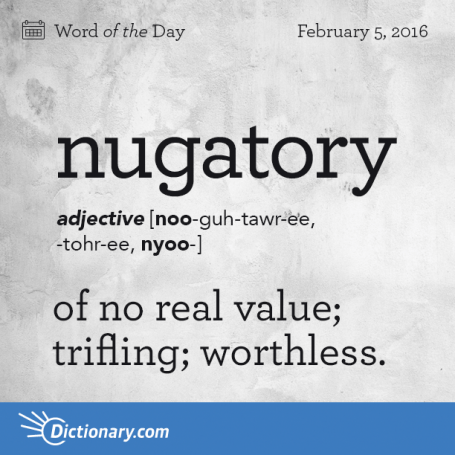
Nugatory – Friday’s Word of the Day Haiku

Happy Friday to you! Today’s Word of the Day from dictionary.com is another one of those dinosaur words. It is a word that appeared in the early 17th century and had a fairly good run of it until the 20th century. One might even say that “Nugatory” is a nugatory word.

So why am I spending an entire post on this nugatory word? Why do I spend any Friday, for that matter, on a nugatory quest in pursuit of interesting anecdotes for nugatory words? (I’m not sure I like this word…it doesn’t roll off the tongue like some words do…perhaps this is why it has gone the way of the dodo!)

And yet here we are. One might say, I pursue these words on a dare. And this is true. I am determined to see it through, this challenge I set for myself to write a haiku based on dictionary.com’s word of the day. Or you might say it is because I have a haiku to write. But I certainly don’t need the added aggravation of trying to fit a long-in-syllable, obsolete word into a haiku when there are plenty of reasonable prompts available to me.

The thing is, when Thursday evening comes, my excitement grows in anticipation of Friday’s word drop. Sometimes I even wait up until midnight to have a look. (Note: the Word of the Day doesn’t post at 00:00:01…just an FYI if you’re interested. Sometimes it doesn’t post for HOURS after midnight.) But it is the surprise of it and the challenge of it that gives me joy! It matters not to me how nugatory a word may be…even if the nugatory word is in fact “nugatory”!

Because words…beautiful words in all their forms, quirks and origins have value in the role that they have played in defining how we have evolved over time. If you don’t believe me, consult the Urban Dictionary to be enlightened.

I admit, I do love reading dictionaries for FUN! And I also love writing Haiku. So what’s not to love about this nugatory weekly practice?! I can’t think of anything! 🙂

Have a great weekend! And if you dare, snuggle up with a good book, like um…a dictionary or an encyclopedia if you’re really looking for something deep! 🙂

From a simple Google Search I found this definition:

nu·ga·to·ry ˈn(y)o͞oɡəˌtôrē/adjective

adjective: nugatory
1-of no value or importance. “a nugatory and pointless observation”
synonyms: worthless, unimportant, inconsequential, valueless, trifling, trivial,
insignificant, meaningless “a nugatory observation”

2-useless; futile.”the teacher shortages will render nugatory the hopes of
implementing the new curriculum” synonyms: futile, useless, vain, unavailing,
null, invalid “the shortages will render our hopes nugatory”

Origin
early 17th century: from Latin nugatorius, from nugari ‘to trifle,’ from nugae ‘jests.’

Nugatory Haiku

nobody listened
her thoughts were nugatory
they assumed…what fools!

we dismiss cursive
as a nugatory form
scorned like the dodo.

it’s nugatory
the way some candidates stump
as if they will win.

kat ~ 5 February 2016


Zenith – Friday’s Word Of The Day Haiku

    
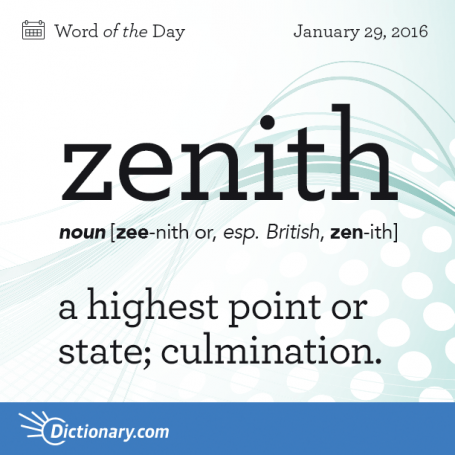
Happy Friday! Today’s Word of the Day from Dictionary.com is Zenith! It originates from the Arabic “samt (ar-ra’s)” meaning “path (over one’s head)”

As I often do when working with words, consulting a Thesaurus helps me understand the nuances of a word. Here are a few synonyms for the word Zenith: highest point, high point, crowning point, height, top, acme, peak, pinnacle, apex, apogee, crown, crest, summit, climax, culmination, prime, meridian.

I also recently discovered another cool tool in Google that allows me to produce a word translated into various languages. The word Zenith has a variety of interesting translations…in Italian, there are three words: zenit, apice and culmine; in Spanish, cenit, apogeo, cumbre, cima and auge; and my new favorite language, German, zenit and Gipfelpunkt! Wow! Being afraid of heights I get dizzy just thinking about it!

In its various translations and definitions zenith represents the pinnacle, apex or high point. There’s just one problem. Gravity. What goes up eventually reaches the highest high it can go and then, well you know.

I suppose the trick to surviving the zeniths in one’s life is learning to scale the thrilling climb to the top and ultimate plunge as if riding a roller coaster. The track doesn’t end at the bottom. It curves around, reaches a few more pinnacles, and does a loop de loop before settling slowly to a smooth stop, leaving the rider exhilarated and breathless!

I don’t know if I’ve reached the ultimate zenith in my life, but I think it’s more about the journey up and back down. The dizzying view from the pinnacle only lasts for a second!

Here’s the Haiku!

Reaching one’s zenith…
It’s truly a triumph!
But then it’s downhill!

kat ~ 29 January 2016


Reify – Friday’s Word of the Day Haiku

reify.png

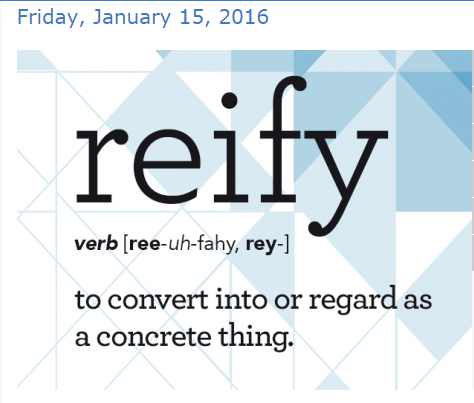
Happy Friday! Today’s Dictionary.com Word of the Day is quite conceptual in nature, while also being rather concrete in meaning. In addition to its general definition, as reflected in the graphic above, it has been applied in reference to Marxism (Click here to read more on that from Wikipedia. ) or regarded as a fallacy of ambiguity according to this wiki source:

From Wikipedia:

“Reification (also known as concretism, hypostatization, or the fallacy of misplaced concreteness) is a fallacy of ambiguity, when an abstraction (abstract belief or hypothetical construct) is treated as if it were a concrete, real event, or physical entity. [1][2] In other words, it is the error of treating something which is not concrete, such as an idea, as a concrete thing. A common case of reification is the confusion of a model with reality: “the map is not the territory”.

Reification is part of normal usage of natural language (just like metonymy for instance), as well as of literature, where a reified abstraction is intended as a figure of speech, and actually understood as such. But the use of reification in logical reasoning or rhetoric is misleading and usually regarded as a fallacy.”

OY!…is your brain hurting yet? Perhaps I should rethink exploring these “words of the day” as a morning practice! I promise, I am not a masochist! To preserve my sanity and brain cells I do sometimes need to let these challenges simmer a bit while my brain acclimates to the shock of being set into high gear.

Today was one of those days! Not to worry…I came up with a handful of haiku. I will leave you with this last thought…an excerpt from LogosJournal’s exploration of the history of the word:

As a synonym of ‘thingification,’ the inverse of personification, reification metaphorically refers to the transformation of human properties, relations, processes, actions, concepts, etc. into res, into things that act as pseudo-persons, endowed with a life of their own. Depending on the grammatical subject of reification – who reifies what: is it the analyst who reifies the concepts or is it society that alienates the subjects? – the transformation of human properties, social relations, abstract concepts, etc. into things, types and numbers can operate both on an epistemological and on a social level.

I rather like reification’s synonyms…”thingification” or “to thingify” as in reify… now this, I get! I have provided the synonym for you if you haven’t had your coffee yet. Now I think it’s time for a nap!  🙂

Reify in Haiku

The past reified (thingified)
is a utopian myth
doomed to a repeat?

some reify (thingify) god
imagining him human
reveals lack of faith.

A reckless notion
is corporate personhood
reification (thingification)?

to say “piece of meat”
is crude reification (thingification)
‘oft uttered by “tools”.

kat ~ 15 January 2016