Tag Archives: Haiku

Trophic – Friday’s Word of the Day Haiku

trophic

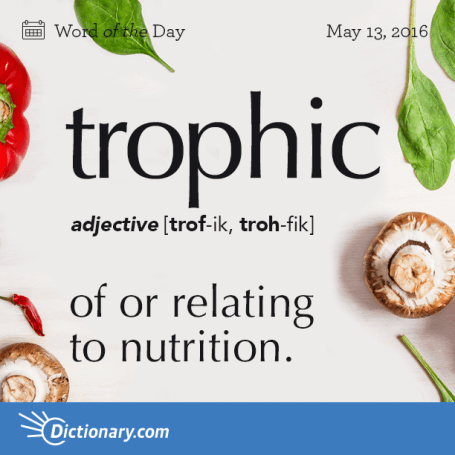
Happy Friday! Today’s Dictionary.com Word of the Day is Trophic. I don’t think I have ever heard this word before. Though I am familiar with trophic levels as they relate to the steps in the food chain. So it is likely that may have seen it in the course of my biology studies. At any rate, it is an adjective.

The Oxford Dictionary defines Trophic as:
1
Relating to feeding and nutrition.

1.1Physiology (Of a hormone or its effect) stimulating the activity of another endocrinegland.

Origin
Late 19th century: from Greek trophikos, from trophē ‘nourishment’, from trephein ‘nourish’.

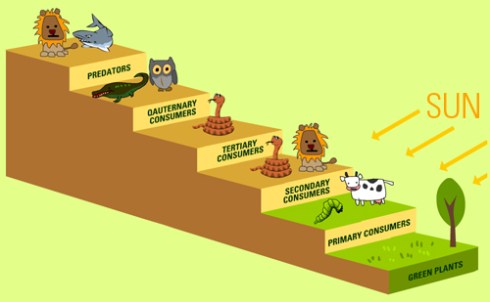
The definition above tests the limits of my left brain! When I set about to research the word, the term, trophic “levels” kept coming up, complete with PICTURES. Now THIS, I can wrap my right-skewed brain around. Thank goodness! Or I might never have been able to wrangle a haiku out of the word. I give you then… Trophic in Haiku…with pictures. 🙂

food-chain-levels

Breaking the Food Chain

Human consumers
top food chain trophic levels
unless they’re vegan.

kat ~ 13 May 2016


Chaos -A Haiku

For yesterday’s Daily Prompt: Chaos


clusters of seedlings
scattered randomly on air
find root from chaos.

©kat 10 May 2016


Turpitude – Friday’s Word of the Day Haiku


Happy Friday! Today’s Dictionary.com Word of the Day is Turpitude. It finds its roots in the Latin term turpis meaning “base, vile”, entering English in the late 1400’s. Today, it is often paired with the word, “moral”. (See below)Happy Friday! Today’s Dictionary.com Word of the Day is Turpitude. It finds its roots in the Latin term turpis meaning “base, vile”, entering English in the late 1400’s. Today, it is often paired with the word, “moral”. (See below)

From Wikipedia:

Moral turpitude is a legal concept in the United States and some other countries that refers to “conduct that is considered contrary to community standards of justice, honesty or good morals. This term appears in U.S. immigration lawbeginning in the 19th century.

The concept of “moral turpitude” might escape precise definition, but it has been described as an “act of baseness, vileness, or depravity in the private and social duties which a man owes to his fellowmen, or to society in general, contrary to the accepted and customary rule of right and duty between man and man.”

Perpetrators of turpitude can be found, of course, filling our prisons, but I can think of a few other places where they might hang out! Here is my haiku then. Have a great weekend! 

Some fill our prisons,
Those guilty of turpitude,
Some are elected!

kat ~ 6 May 2016


Friday’s Word of the Day Haiku


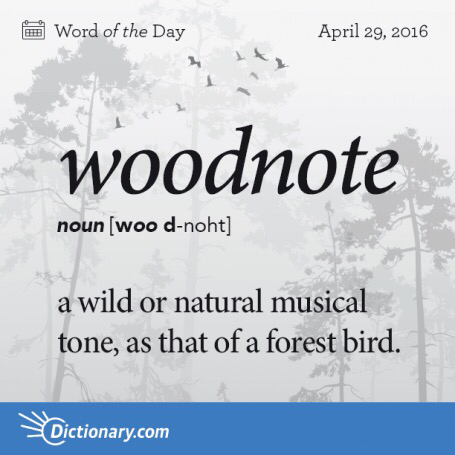
Happy Friday! What a lovely, lyrical word we have today…”Woodnote!” When I first saw the word this morning, I imagined that it must have had its origin in the mind of some 17th Century poet who penned it on parchment giving it life!

Dictionary.com simply mentioned that it came into use around 1632. And of course that was my cue to dig a little deeper. No other dictionary expounded further on the issue but I was determined to find the poet who first wrote it … I was certain it was a poet…a poet knows these things…😉

How do I love the Internet…oh let me count the ways…not the least of which, it brings the world to one’s computer screen! After a bit of search engine tweaking, I found my bard!!! Oh yes, my hunch was correct. And what was even more spectacular? The man who coined the word woodnote in 1631 (later published in 1645) used it to describe THE quintessential Bard, Shakespeare. Mystery solved!

Who is the poet? He is John Milton who, in “L’Allegro,” refers to Shakespeare as “Fancy’s child” who warbles “his native woodnotes wild.” You can read the entire poem HERE.

From the Encyclopedia Britannica…

L’Allegro, early lyric poem by John Milton, written in 1631 and published in his Poems (1645). It was written in rhymed octosyllabics. A contrasting companion piece to his “Il Penseroso,” “L’Allegro” invokes the goddess Mirth, with whom the poet wants to live, first in pastoral simplicity and then amid the “busy hum of men” in cities full of vitality.

And so, my challenge today is to pen a simple haiku using woodnote as my prompt. I do so hoping to channel a wee bit of Milton who gave us this wonderful word. Oh, if only. But knowing its origin makes my task so much sweeter!

heartsong

Of lilting woodnotes…
birdsong, wind-tossed forest whispers…
these make my heart sing!

kat ~ 29 April 2016


Nana’s Jewel Box -A Haiku

This Haiku is in response to TJ’s Household Haiku Challenge prompt: “Jewel Box”. to read other haiku click HERE.

Photo from Pixabay.com


Pearlescent gems
Sleep on waves of red velvet
nana’s jewel box.

kat ~ 28 April 2016