Tag Archives: dictionary.com

Backronym – Friday’s Word of the Day Haiku

backronym.png

I LOVE today’s word of the day on dictionary.com! Backronym. Not to be confused with its cousin, the acronym, a word formed by using the first letters of a phrase, a backronym is a phrase generated using the letters of existing word or name. The word “Backronym” is itself a portmanteau (Remember that word of the day? A word formed by combining the elements of two words?) Backronym, the word, is formed by combining the word “backward” with “acronym”.

Some of the more common backronyms that you may be familiar with are: AMBER (America’s Missing: Broadcast Emergency Response) Alert, SAD (Seasonal Affective Disorder), ZIP (Zone Improvement Plan) Code, and my personal favorite, SPAM (Something Posing As Meat). creating backronyms can be fun, inspirational as in the Alcoholics Anonymous words, SLIP (Sobriety Losing Its Priority) and DENIAL (Don’t Even Notice I Am Lying), and functional, as illustrated by the military’s extensive use of backronyms for various operations: CAT (Crisis Action Team), WASP (World War II’s Women Airforce Service Pilots), the US military’s personnel and benefits database, DEERS (Defense Eligibility Enrollment Reporting System), and WOMBAT (Worldwide Observatory of Malicious Behaviours and Attack Threats) project. The military is a prolific promoter of backronyms. I am reminded of my own days as a young Marine taunted by my male counterparts’  cat-calls, “BAM” (Broad Ass Marine). Yes, the possibilities are endless!

My research into this word revealed an online Backronym Maker and a helpful site that gave the history of words assumed to be acronyms that are actually backronyms. The word was coined by Washington Post reader Meredith Williams of Potomac, Maryland who entered and won the paper’s monthly Neologism Contest in November 1983. She defined it as “the same as an acroynym, except that the words were chosen to fit the letters”. And the rest, as they say, is history! Since it is a relatively new word, it’s worth noting that there are opposing views as to whether a word is a true acronym or if it is, in fact, a backronym. It’s a “chicken or the egg” dilemma, but I think it is safe to assume that if a phrase is formed from an existing word, it might be a backronym.

And then, there are “initialisms”, also called abecedisms  (isn’t that an interesting word!) which is a term formed from the initial letter or letters of several words or parts of words, but which is itself pronounced letter by letter. Examples include ABC (American Broadcasting Company), DVD (Digital Versatile Disc), HTML (HyperText Markup Language), IBM (International Business Machines Corporation), and ATM (Automatic Teller Machine) A bit off-topic, I know, but aren’t you glad to know about initialisms too! I know I am! 😉

Here’s a Haiku to put this one to rest. Rather than use the actual word, I decided to create an example of today’s word of the day from the word “HAIKU) Have a great weekend.

HAIKU

Heady Artistic
Inspirations, oft’ Kitschy,
though Understated

~kat
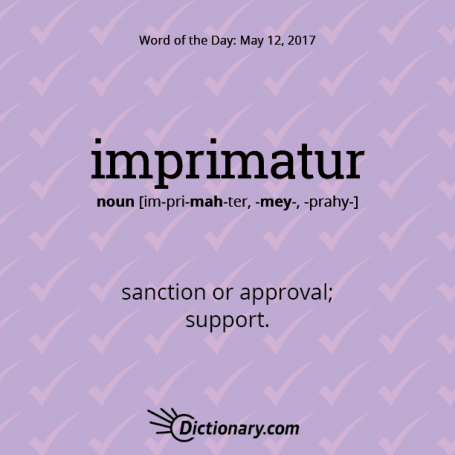

Imprimatur – Friday’s Word of the Day Haiku

imprimatur.png

Missed yesterday…I need a less crazy day job so I have evenings to write. By the time I get home it’s time for bed and then to start again. At any rate, the word of the day for Friday from dictionary.com was imprimatur.

Dictionary.com defines imprimatur as  an official license to print or publish a  book,  pamphlet, etc., especially a license issued  by a censor of the Roman Catholic Church; or simply a sanction or approval; support. The word originated in 1640, Modern  Latin, literally “let  it be printed,” the formula of a book licenser, third person singular  present  subjunctive   passive of Latin  imprimere “to print” (see impress). Originally of state license to print books, later only of Roman Catholic Church.

A peruse of Wikipedia revealed that the word actually dates back to the dawn of printing. In England the Licensing of the Press Act of 1662 required an official license for printing books. The 1662 act required books, according to their subject, to receive the authorization, known as the imprimatur, of the Lord Chancellor, the Earl Marshall, a principal Secretary of State, the Archbishop of Canterbury, or the Bishop of London. Essentially, t was government ordered and sanctioned censorship. Those who broke this law could be sued for libel. The law finally expired in 1695.

Shortly after its expiration the first significant event in the evolution and history of the copyright, the Statute of Anne in 1710 (Anne being Queen Anne), removed the right to print and publish a written work from publishers, printers and the state, returning it to the authors as a way to encourage learning and the sharing of ideas.

Here is an excerpt from the statute: Whereas Printers, Booksellers, and other Persons, have of late frequently taken the Liberty of Printing, Reprinting, and Publishing, or causing to be Printed, Reprinted, and Published Books, and other Writings, without the Consent of the Authors or Proprietors of such Books and Writings, to their very great Detriment, and too often to the Ruin of them and their Families: For Preventing therefore such Practices for the future, and for the Encouragement of Learned Men to Compose and Write useful Books; May it please Your Majesty, that it may be Enacted ..

Thank you Queen Anne! Despite its flaws the statute was a significant game-changer. Eventually copyright law has evolved to include protections for sheet music, audio – voice and music, media broadcasts, film and television, internet content and intellectual property.

But back to our word of the day. I for one am glad that I don’t need to obtain an imprimatur for the words I write here on this blog or for any words I might decide to publish in print. Freedom of expression enriches us all.

freedom to express
needing no imprimatur
enriches the mind

~kat


Abrazo – Friday’s Word of the Day Haiku

In honor of Cinco de Mayo, the word of the day is a Spanish from dictionary.com…Abrazo! Dictionary.com defines abrazo as “an embrace used in greeting someone. Spanish abrazo and Italian abbraccio, both meaning “a hug, an embrace” come from the Latin prefix (and preposition) ad- “to, at, near” and Spanish brazo and Italian braccio “arm” both come from Latin brachium. Abrazo entered English in the 17th century.”

Sadly, though abrazo was added to the English vocabulary, you’ll not get any points in Words With Friends or the English versions of Scrabble. It’s not recognized as a word. Sorry to rock your tile tray, my wordie friends. 😟

Still there is something to be said for the concept of the abrazo. Modern society is quite averse to physical contact between acquaintances or strangers. Egads! Don’t invade anyone’s personal space without being invited or asking permission, or you might find yourself the defendant in a nasty lawsuit.

This makes socializing a bit awkward for a hugger like me. Though I don’t typically ask permission, per se. I simply declare that I am a hugger upon meeting someone and take my cue based on their expression as to whether I proceed. A smile means “go”. “Deer in the headlights” or a step backwards is a definite “No”. The “no’s” will generally reach for a handshake. But the smiles? I love it when I find another hugger.

Now, I know what you’re thinking, “She hugs on the first meet?” I do. I wish we all did more hugging. There is nothing like a genuine abrazo to lift one’s spirits and connect one human to another. Might even change the world if we weren’t afraid to hug. Just sayin’.

May your life be filled with peace, love and lots of abrazos! Here’s this week’s Haiku.

embrace with your heart
give abrazos, full-frontal,
side hugs are for stiffs

kat


Jammy – Friday’s Word of the Day Haiku

jammy

Happy Friday! Today’s Dictionary.com Word of the Day is Jammy. Now, if you are living in the US you might be thinking that this word is a short version or slang for the word pajamas. And you’d be right.

Then there are our neighbors across the pond who define Jammy altogether differently. To be “jammy” is an enviable place to be indeed. It means to be “very lucky”.

Unless of course your referring to something that has jam, is covered in jam, or filled with jam…then saying jammy would mean something entirely different, like a jammy doughnut.


_88667329_alamy_jammie976

Jammie Biscuits

I also discovered that there is a delicious British biscuit made of shortbread and a layer of raspberry jam called a Jammie Dodger. Note to self…if I ever happen to find my way across the Atlantic, must try these yummy “cookies”.

The word originated in the 1800’s in its English form. It is associated with several idioms that all relate to having an easy go of things…or luck: to have  jam on it “to have something easy,”  real jam or pure jam, “something  easy or pleasant.

As I consider the various uses we have for this word I am imagining how jammy I would be if I could spend the day in my jammies eating Jammy Dodgers. (with a cuppa tea of course!) Ah…bliss!

Here’s a haiku too. Now back to my daydreaming about being so jammy!

Jam, Jammy, Jammies

perfect job and life
we should all be so jammy
not stuck in a jam

~kat


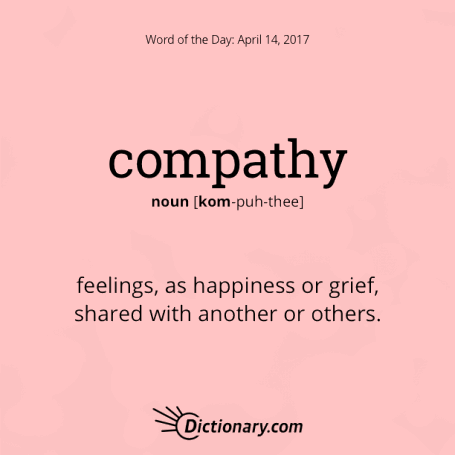
Compathy – Friday’s Word of the Day Haiku

compathy.png

Happy Friday! Well here is a new word for you…”Compathy”, Dictionary.com’s Word of the Day. It is another word to add to your arsenal of “feeling” words like Sympathy and Empathy, but with just enough of a subtle difference that you may find yourself needing to use it more and more.  The suffix of all three words is –pathy from the Greek ‘patheia’ which means ‘suffering’ or ‘feeling’.

Sympathy’s prefix, sym- comes from the Greek sum or sún, meaning “with, in company with or together with.” While feelings are part of the word, it is possible to be sympathetic without actually feeling what others are feeling. For example one could be sympathetic to a cause. One who is sympathetic might be overheard saying, “Oh poor so-and-so…” and in the next breath commenting, “I’m sure glad it’s not me.” So much for sympathy. No wonder  we are loath to sympathy from others. It smacks of pity.

Enter Empathy. From the Greek ‘empatheia’, when one combines em + pathy the literal meaning is ‘in’ + ‘feeling’.  It’s a feel good word…much more to our liking than sympathy. Having empathy is the ability to put yourself in someone else’s shoes; to consider their plight while also considering how you might feel in the same circumstance. It’s a bit more engaging. Being empathetic moves us emotionally and compels us to act with compassion, but it is not the ultimate of –pathies. One can remain detached more or less and still feel and respond with empathy.

Which brings me to today’s word of the day, Compathy. It’s little prefix of a word, ‘com’ is a loaded when you add it to -pathy.  For this word’s etymology we turn to the Latin ‘com-‘ or ‘cum’ which means “together with, similar, extremely, completely.”  Compathy contains an intensity that the other two words do not.  Compathy is defined as “feelings, as happiness or grief, shared with another or others.” There is no detachment here, no standing on the sidelines. To have compathy means to feel the intense emotions of another with that other person or persons as if you share the same heart.

I can understand why compathy is more obscure than the other two words. Have you ever heard of it? I know I hadn’t.  And my ignorance allowed me to be quite content, considering myself a caring, feeling, empathetic person…which is a good thing, right? The fact is my ability to care has now been challenged to rise to the next level; to allow myself to enter into the suffering and joy of others whole heartedly and with abandon.

We call a person who acts and feels this way an “empath”, but I believe we have it wrong. Empaths are truly Compaths when you get right down to it. And it’s something to aspire to. Not because I’m a masochist but because I believe having compathy is the one true way to connect with another person in a deep and meaningful way. It’s where love and healing and true joy happen.

Have a great weekend. Peace and love to you and yours.

sympaths say “poor you”
empaths say “poor you, I know…”
but compaths say “we”

~kat – 14 April 2017