
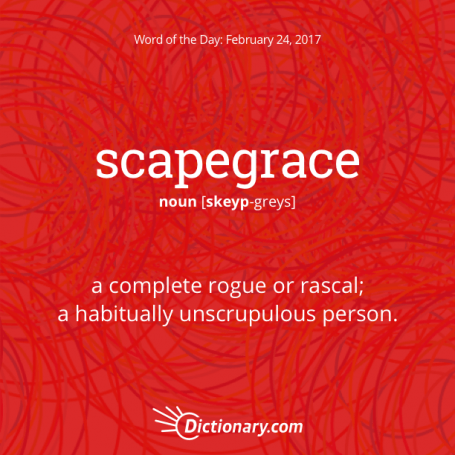
Happy Friday! Today’s Word of the Day from Dictionary.com is “Scapegrace”. When I first saw it, I thought of the common term scapegoat, but this word has very little to do with scapegrace, unless of course you are talking about the poor sap who finds himself in the company of a scapegrace; blamed for the unscrupulous deeds of their grace-less scoundrel of a friend! Then the two fit together, albeit uncomfortably, like two peas in a pod.
Scapegrace is defined by various online dictionaries as a complete rogue or rascal; a habitually unscrupulous person; scamp; a reckless and unprincipled reprobate; or a kinder definition states, “A man or boy of reckless and disorderly habits; an incorrigible scamp. Often used playfully.” A common synonym for the word is “black sheep”. You get the picture. You likely have a picture in your mind right now of a particular scapegrace you might know. (not going to mention any names here 😉 )
The word entered the English language in the mid 18th to early 19th century, over 200 years after the word “scapegoat” came into play, which is rather ironic in retrospect. It took two centuries for scapegrace to become a word, leaving poor old scapegoat to face the music alone. One wonders if it was just hiding all those years.
Scapegrace is made up of the verb “scape” which is a variant of “escape” and the noun “grace”, which literally means “one who escapes or flees the grace of God.”
Oh, and there is one other obscure meaning associated with the word. Scapegrace, in ornithological (the branch of zoology that deals with birds) circles, can also refer to a red-throated loon or diver. Like other loons scapegrace loons are primarily fish eaters and monogamous. Their red throat comes into play during mating rituals. They are not particularly graceful on land due to the positioning of their legs toward their back ends. In fact, the word loon is thought to be derived from the Swedish “lom” which means “lame” or “clumsy”, but this is said to give them great mobility and thrust in and under water. They are excellent swimmers taking to the water only days after hatching.
They are also associated with the creation mythology of indigenous peoples, given the name “earth-diver” in one such story. As legend goes, the Red-Throated Diver was asked by a great shaman to bring up the earth from the bottom of the sea. This is how the world’s dry land was formed.
Through the years the loon was also used as a weather predictor. Move over Mr. Ground Hog! Depending on the location, some people believed it would be fair or rainy based on the direction of the scapegrace’s flight (inland – nice weather or out to sea – not so nice). Other communities relied on its various calls to determine the weather; a gaa-gaa-gaa or turkatrae-turkatrae meant nice weather, whereas meowing like a cat was a sure prediction of rain. With few predators the oldest known Red-Throated Loon, found in Sweden, lived to be about 23 years.
So there you have it, a glimpse into another odd word that we rarely use these days with an avian link associated with its meaning. I’m beginning to see a trend here! What to do, what to do with this week’s Haiku…scapegoats, but not scapegoats and scapegraces and loons…
If you’re a scapegoat
you likely know a scapegrace
who is a bad egg!
~kat – 24 February 2017
Have a great weekend!





 like mercury colliding...