Tag Archives: dictionary.com

Esoterica – Friday’s Word of the Day Haiku

esoterica.png

Happy Friday. Today’s Dictionary.com word of the day is Esoterica. But I couldn’t resist the word of the day for yesterday…Throttlebottom (Definition: a harmless incompetent in public office.)! What an awesome word. Oh how I wish we used these types of words today. How enjoyable the nightly news would be if our journalists embraced some of the other obscure, descriptive words featured as words of the day. I wish I had time to research each one. Here’s a sampling of the last week or so…

Breaking news from kat’s imagination: “Today was a most cimmerian day for the nation. The halls of congress were a-twitter with crocodilian calls for justice in response to the latest canard from our vaunting, throttlebottom of a president. Meanwhile the lotus-eaters were oscitant to this developing malfeasance.”

Even if the news is bad, at least it would be entertaining.

But back to our official word of the day, Esoterica. It is a noun that evolved from the Greek adjective esōterikós which means “belonging to the initiate, inner, esoteric” with a “distinguished history in ancient Greek philosophical systems (Pythagorian, Aristotelian, Stoic).” The English noun form is attributed to poet Ogden Nash who used the term in a 1930’s poem published in The New Yorker, referring to the obscenity trials over James Joyce’s Ulysses. It is defined as things understood  by or meant for a select few; recondite  matters or items.  Or curiosa (books,  pamphlets,  etc.,  dealing with unusual subjects, including books, pamphlets, etc., containing pornographic  literature or art; erotica).

I like this quote from Lemony Snicket’s A Series of Unfortunate Events, “Life is a conundrum of esoterica”.  It literally means that life is a confusing and difficult problem, question or riddle, understood by or meant to be understood by a select few. I think it captures the meaning of esoterica perfectly!

Unless of course it is a skin cream. Esoterica the moisturizer promises to lighten dark (brownish) areas on the skin, such as freckles, age and liver spots and other skin conditions that result in localized high concentrations of melanin.

Or a Black/Heavy Metal music band called Esoterica from Pennsylvania…or the now disbanded UK Christian rap/West Coast hip-hop, Dance/Electric band called ESO for esOterica…or the name of a secret cult of humanoid characters, with access to alien technology, able to span dimensions, called the The Flame Keepers’ Circle in the gaming world’s story of Diagon. But I digress. 🙂

My job today is to come up with a haiku using today’s word of the day…Esoterica. Skin creams, Metal/Alertnative/Rock bands and video cult circles aside, I am mulling around the idea of applying estoterica to the current secretive nature of our government. With the added bonus of yesterday’s word, throttlebottom, you get a two-fer this week. Have a great weekend!

daft throttlebottoms
bellow esoterica
proving they are fools

kat ~ 24 March 2017

Smaragdine – Friday’s Word of the Day Haiku

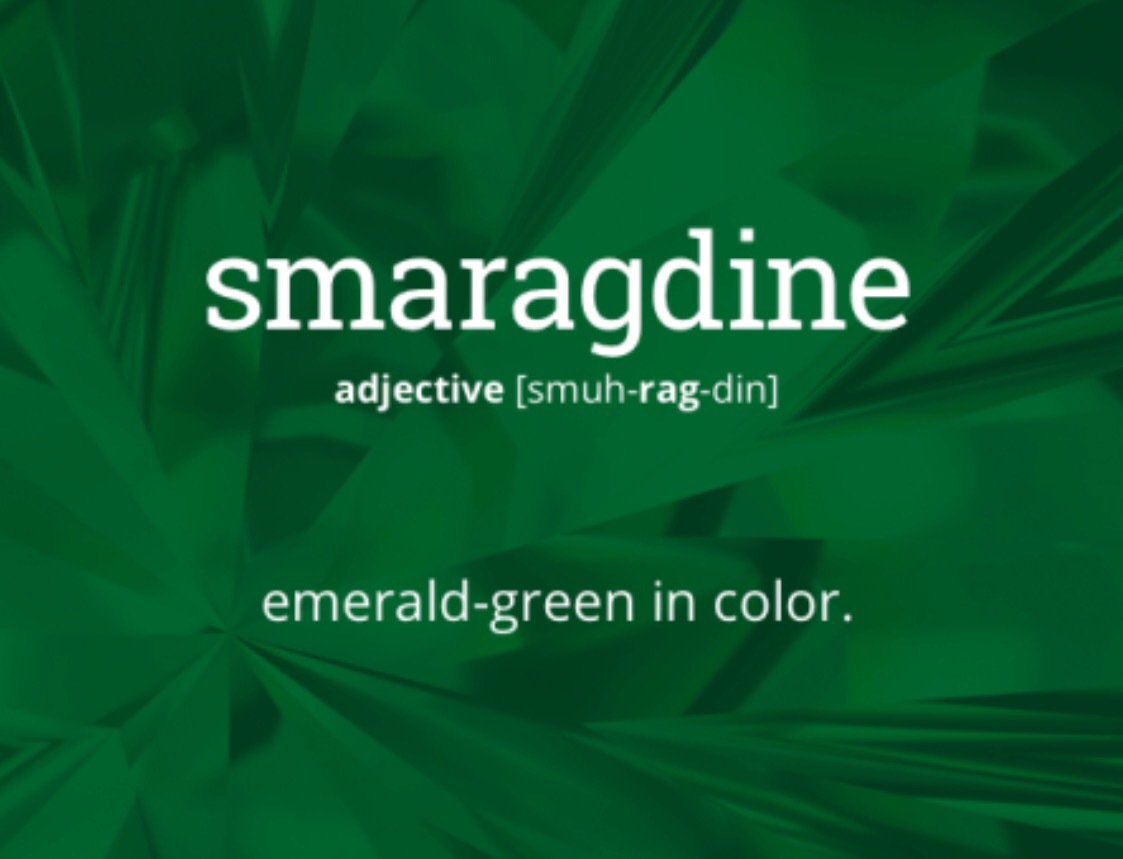
Happy Friday. And Happy St. Patrick’s Day! Dictionary.com‘s perfect word for today is Smaragdine, which means of or relating to emeralds; emerald-green in color. Perfect right? It’s originated around 1350–1400 from the Middle English word smaragd that literally means “emerald” as well as Latin smaragdīnus and Greek smarágdinos, which are equivalent to smáragd(os).

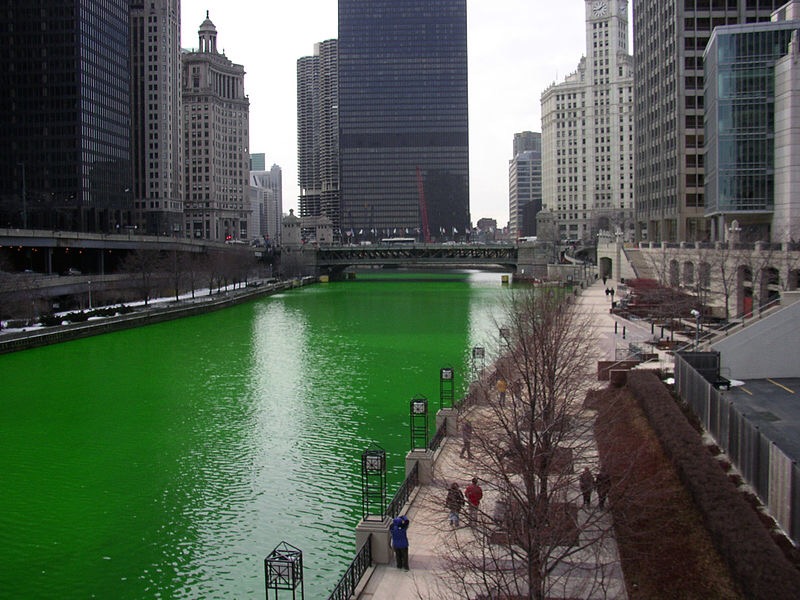
Of course on a day like today I naturally think of my Irish heritage and my Chicago roots where the river through the city runs green every year. Here’s a little history about the river that I found on Wikipedia:

The tradition of dyeing the river green arose by accident when plumbers used fluorescein dye to trace sources of illegal pollution discharges. The dyeing of the river is still sponsored by the local plumbers union.

The United States Environmental Protection Agency (EPA) outlawed the use of fluorescein for this purpose, since it was shown to be harmful to the river. The parade committee has since switched to a mix involving forty pounds of powdered vegetable dye. Though the committee closely guards the exact formula, they insist that it has been tested and verified safe for the environment. Furthermore, since the environmental organization Friends of the Chicago River believes the dye is probably not harmful, they do not oppose the practice.


In 2009 First Lady Michelle Obama, a Chicago native, requested that the White House fountains be dyed green to celebrate St. Patrick’s Day.

Clearly that smaragdine river leaves quite an impression on us Chicago daughters!

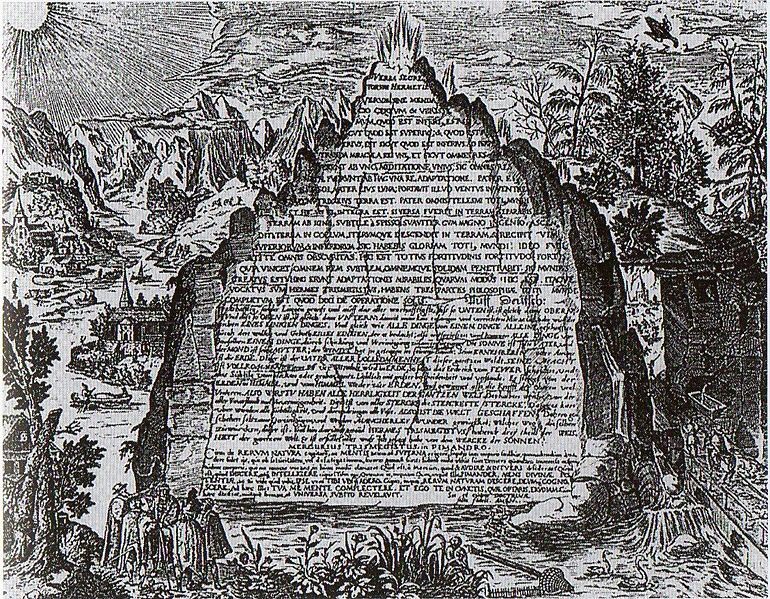
An imaginative 17th century depiction of the Emerald Tablet from the work of Heinrich Khunrath, 1606.


I found one more cool reference to the word. It has to do with an ancient cryptic piece Hermetic lore called the the Smaragdine Tablet. It’s origin is a point of debate, with some scholars who believe it to be 1200 years old and others who claim that it is over 38,000 years old, chiseled into a smaragdine tablet by the gods. It has been associated with the philosopher’s stone, laboratory experimentation, phase transition, the alchemy and magic.

There is even a reference from the tablet in the Gnostic Gospels of Phillip and Thomas in the text “above and below” as much as “inside and outside.” You can read more HERE.

And there is even a modern reference to the tablet in the 2006 miniseries, “The Curse of King Tut’s Tomb”. If you have several hours to kill, you can spend some time researching this tablet. It’s definitely an interesting read if you like a good mystery.


Which brings me back to Chicago and the green river and St. Paddy’s Day. Trust me it does….take me back, that is. When I was a girl I always believed that it was the magic of leprechauns who turned the river green.

We all need a bit of magic and mystery every now and again so we don’t take ourselves and the crazy realities of the world too seriously. I think I understand why Mrs. Obama asked for that green fountain on March 17th. I find myself googling Chicago every year to see the green river. As crazy weird and mysterious as it is, it gives me comfort and memories of home…and of course Spring! 

Sláinte ~ kat

smaragdine rivers,
stones etched mysteriously
greening is magic

kat – 17 March 2017


Stravage – Friday’s Word of the Day Haiku

stravage

Happy Friday. Today’s Dictionary.com Word of the Day is Stravage.

Originally entering the English language in the late 18th century this Scottish/Irish word is derived from an aphetic contraction, which means that it is a word formed by combining two words as well as by aphesis (the loss of an unstressed vowel at the beginning of a word (e.g., of a from around to form round ).

From Medieval Latin we have ‘extravigari’ which means to wander out of bounds, digress or ramble. ‘Vagare’ is an Italian intransitive verb that means: to wander aroundroam around, to roam. I particularly like this Italian phrase: “vagare con la fantasia” which means to give free rein to one’s imaginationlet one’s imagination run away with one.

And to round out the etymology of this most interesting word, the Italian verb ‘vagare’ or ‘vargari’ is derived from the adjective ‘vagus’ which means strolling or unsettled and is thought to be a precursor of the English word ‘vagrant’. Back to our word, stravage. To get to its current form, the “ex” from the original Latin ‘extravigari’ was dropped by the Scots who converted the word to ‘stravaig’. It was later embraced by the English, dropping the ‘i’and adding an ‘e’.

I was able to find a delightful, award-winning Glasgow restaurant called Stravaigin in my stravaging across the internet. True to its name, their website’s “About” page links us back to this 18th century word: “‘Stravaig’ meaning ‘to wander’ encompasses our ‘Think Global, Eat Local’ ethos perfectly. So wander off the beaten path into either the street level cafe bar or the downstairs restaurant where you’ll find menus showcasing Scottish produce that isn’t tethered to its roots. Awarded the Michelin Bib Gourmand every year since 2012.” Stravaigin is quite modern however, offering local fare with an exotic flare. Click on the link of their name above to check them out. If ever you’re in Glasgow…;)

The Scots, I have learned, are very proud of their native language and heritage. There is an entire website devoted to all thing Scots…but I suppose I am digressing…or stravaging you might say. Since I am descended from Scottish ancestors, this will be on my to-do list for future study. 🙂

I am quite fond of stravaging. I admit that I do it often! Those who know me are able to recognize my stravaging ways immediately. I am told my eyes glaze over and I may start humming a tune to myself, which drives people batty. But in my mind, I am having a jolly good time taking it all in. The scenery that is. I am not so worried about the destinations in life that I do not pay good mind to the journey. The journey after all is where it’s at. (whatever “it” may be) I have a tin plaque in my room that says, “I never worry when I get lost, I just change where I want to go.” A friend got it for me. Stravage is a good word of the day for me. Fits me to a “t”. Have a great Friday!

to those who stravage
some may think you’re a lost fool
 but you are seeking 

to be an artist
it helps to be an odd bird
with stravaging wit

delicate ivy
stravages up walls, clinging
destruction’s embrace

~kat – 10 March 2017


Scapegrace – Friday’s Word of the Day Haiku

scapegrace

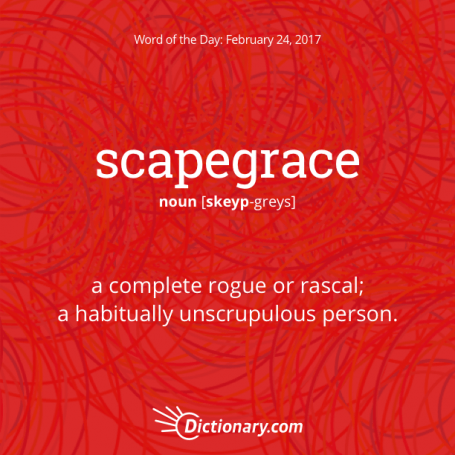
Happy Friday! Today’s Word of the Day from Dictionary.com is “Scapegrace”. When I first saw it, I thought of the common term scapegoat, but this word has very little to do with scapegrace, unless of course you are talking about the poor sap who finds himself in the company of a scapegrace; blamed for the unscrupulous deeds of their grace-less scoundrel of a friend! Then the two fit together, albeit uncomfortably, like two peas in a pod.

Scapegrace is defined by various online dictionaries as a complete rogue or rascal; a habitually unscrupulous person; scamp; a reckless and unprincipled reprobate; or a kinder definition states, “A man or boy of reckless and disorderly habits; an incorrigible scamp. Often used playfully.” A common synonym for the word is “black sheep”. You get the picture. You likely have a picture in your mind right now of a particular scapegrace you might know. (not going to mention any names here 😉 )

The word entered the English language in the mid 18th to early 19th century, over 200 years after the word “scapegoat” came into play, which is rather ironic in retrospect. It took two centuries for scapegrace to become a word, leaving poor old scapegoat to face the music alone. One wonders if it was just hiding all those years.

Scapegrace is made up of the verb “scape” which is a variant of “escape” and the noun “grace”, which literally means “one who escapes or flees the grace of God.”

Oh, and there is one other obscure meaning associated with the word. Scapegrace, in ornithological (the branch of zoology that deals with birds) circles, can also refer to a red-throated loon or diver. Like other loons scapegrace loons are primarily fish eaters and monogamous. Their red throat comes into play during mating rituals. They are not particularly graceful on land due to the positioning of their legs toward their back ends. In fact, the word loon is thought to be derived from the Swedish “lom” which means “lame” or “clumsy”, but this is said to give them great mobility and thrust in and under water. They are excellent swimmers taking to the water only days after hatching.

They are also associated with the creation mythology of indigenous peoples, given the name “earth-diver” in one such story. As legend goes, the Red-Throated Diver was asked by a great shaman to bring up the earth from the bottom of the sea. This is how the world’s dry land was formed.

Through the years the loon was also used as a weather predictor. Move over Mr. Ground Hog! Depending on the location, some people believed it would be fair or rainy based on the direction of the scapegrace’s flight (inland – nice weather or out to sea – not so nice). Other communities relied on its various calls to determine the weather; a gaa-gaa-gaa or turkatrae-turkatrae meant nice weather, whereas meowing like a cat was a sure prediction of rain. With few predators the oldest known Red-Throated Loon, found in Sweden, lived to be about 23 years.

So there you have it, a glimpse into another odd word that we rarely use these days with an avian link associated with its meaning. I’m beginning to see a trend here! What to do, what to do with this week’s Haiku…scapegoats, but not scapegoats and scapegraces and loons…

If you’re a scapegoat
you likely know a scapegrace
who is a bad egg!

~kat – 24 February 2017

Have a great weekend!


Whiffler – Friday’s Word of the Day Haiku

whiffler.png

Happy Friday! Today’s Dictionary.com Word of the Day is “Whiffler”. The pop up meme for today’s word defines whiffler as “a person who frequently shifts opinions, attitudes, interests, etc. You know, your basis politician!

But as is the case with most words, there is more to the story. Oh yeah, there definitely is. A quick survey of other dictionaries revealed a few more facets to this fun to say word.

Whiffler Definitions
Webster’s Revised Unabridged Dictionary

  1. Whiffler An officer who went before procession to clear the way by blowing a horn, or otherwise; hence, any person who marched at the head of a procession; a harbinger.”Which like a mighty whiffler ‘fore the king,
    Seems to prepare his way.”
  2. Whiffler One who plays on a whiffle; a fifer or piper.
  3. Whiffler One who whiffles, or frequently changes his opinion or course; one who uses shifts and evasions in argument; hence, a trifler.”Every whiffler in a laced coat who frequents the chocolate house shall talk of the constitution.”
  4. Whiffler(Zoöl) The golden-eye.

Century Dictionary and Cyclopedia

  1. n-whiffler A piper or fifer.
  2. n-whiffler A herald or usher; a person who leads the way, or prepares the way, for another: probably so called because the pipers (see piper,1) usually led the procession.
  3. n-whiffler One who whiffles; one who changes frequently his opinion or course; one who uses shifts and evasions in argument; a fickle or unsteady person.
  4. n-whiffler A puffer of tobacco; a whiffer.
  5. n-whiffler The whistlewing, or goldeneye duck.

I discovered that there are two different references relating to the origin of the word, depending on the definition applied. First, around 1530-40, a whiffler was defined as an armed attendant who cleared the way for a procession derived from the Old English wifle or wifel for spear or  battle-ax. Later, between 1600 – 1610 the moniker ‘Whiffler’ was applied to a person who frequently shifts opinions, vacillates or is evasive in an argument. Somewhere in the time between these two definitions, some suggest because whifflers who wielded flags or spears stirred up “whiffles of wind”, whiffle came to be defined  as  wind that blows in puffs or slight gusts, or veered or shifted about. This may explain how the definition morphed from armed attendant to bloviating bag of wind (aka one who is shifty or evasive, or a trifler), but there is more to the story of this word. It is also used synonymously with the word piper, as in one who plays a fife. Still more wind references.

I also happened upon the recollection of 20th century Thomas Ratcliffe, a contributor to Notes and Queries who wrote about the “art of the Whiffle-Waffler”. It was apparently a common art, or sport as I would call it, where boys and men would twirl sticks with their hands, around their bodies and heads, behind their backs, under their thighs and high up in the air, catching them with great precision. Uh…sounds a bit like baton twirling to me. 🙂 Apparently it was a classy “thing” back in the day and an art practiced exclusively by men. At any rate, the “art” of whiffle-waffling apparently died out in the mid 19th century. There is a sad story penned by George Borrow in his work The Romany Rye in 1857 that states, “The last of the whifflers hanged himself about a fortnight ago … from pure grief that there was no further demand for the exhibition of his art, there being no demand for whiffling since the discontinuance of Guildhall banquets.” 

The article I read on the topic also encouraged one to imagine the drum major or field commander of a marching band who leads with a baton or military mace. While not directly related, the author suggested that we can imagine the two side by side, an armed attendant leading a royal entourage and a baton wielding band leader leading a drum corps.

So there you have it. Whiffler and its many iterations and applications over the years…except for just one teeny, tiny, little thing. There’s more.

Whiffler can also be another name for the Goldeneye long-tailed duck or Whistlewing, so called because of the whistling sound that it makes when it flies. Ok…related to the wind…that fits. But what does a duck have to do with the original Dictionary.com definition? Except maybe to say… “If it looks like a duck, swims like a duck, and quacks like a duck, then it is probably a duck.”

I better just get to my haiku’s (I have two of them for you today)…and wish you a happy weekend!

Whifflers

A shifty whiffler
spinning alternative facts
loves gullible fools

Some whifflers whiffle
while some others may waffle
unless they’re a duck

kat – 10 February 2017