Tag Archives: dictionary.com

Alliaceous – Friday’s Word of the Day Haiku

alliaceous

Today’s word of the day from Dictionary.com stems from the Latin “allium” meaning “garlic”. An adjective, alliaceous is a botanical term that can be used to describe plants of the allium genus or the pungent aroma wafting from things alliaceous.  An expanded definition from Collins English Dictionary states:

  1. of or relating to Allium, a genus of plants that have a strong onion or garlic smell and often have bulbs: family Alliaceae. The genus occurs in the N hemisphere and includes onion, garlic, leek, chive, and shallot
  2. tasting or smelling like garlic or onions
  3. of, relating to, or belonging to the Alliaceae, a family of flowering plants that includes the genus Allium

Delicious garlic infused pasta is a tempting aromatic dish, but something happens once it hits our tongue, rendering us unapproachable, victims of “garlic breath”. Still, I have to admit I can’t resist these savory roots: onions, garlic, shallots, chives, leeks. They add wonderful flavor and character to the food that we hate to love. The best way to have your alliaceous favorites and eat them too, is to invite a friend to join you. Amazingly, in this case, two offenses really do make it right. You’ve heard the saying…(well maybe not, but here goes)…”Friends don’t let friends eat garlic alone!” Good advice for the next time you have a hankering for something garlicky.

Have a wonderful weekend! 🙂

Alliaceous Haiku

From halitosis
gourmets smell atrocious
hints, alliaceous.

Alliaceous plants
are prized as medicinal
not for their odor!

Fend off friends and fiends
donning alliaceous bulbs,
nature’s repellent.

From nana’s kitchen…
tempting alliaceous scents
must be pasta night!

kat ~ 17 June 2016


Olykoek – Friday’s Word of the Day Haiku

olykoek

Today’s Dictionary.com Word of the Day comes to us from the Dutch. It is “olykoek” which translated means, “oily cake” or “oil cookie”. Here in the US we would simply call one of these fried confections a donut. I would imagine this is today’s word because today is, in fact, National Donut Day here is the US.

According to Dictionary.com olykoek is an Americanism with roots in New York Dutch. It is formed on the basis of the Dutch oliekoek meaning “oilseed cake,” equivalent to olie, “oil” plus koek, “cake.”

Wikipedia offers additional insight into this word. Olykoek has gone through several evolutions trading popularity with a similar term oliebol or olybollen, translated “oily ball(s)”, depending on which dictionary one consulted at a particular point in history. In fact, “the 1868 edition of the Van Dale dictionary included the word obiebol, while its rival Woordenboek der Nederlansche taal didn’t include it until 1896, stating that the “oliekoek” is a more commonly used term.” And yet another shift occurred in the early twentieth century when oliebol once again became the popular term.

At any rate, olykoeks have been featured in fine art and literature, most notably, Washington Irving’s The Legend of Sleepy Hollow. It seems Ichabod was more enraptured with the sight of sweet Dutch pastries than he was of beautiful voluptuous maidens encountered in Van Tassel’s parlor! Here’s an excerpt:
“Fain would I pause to dwell upon the world of charms that burst upon the enraptured gaze of my hero, as he entered the state parlor of Van Tassel’s mansion. Not those of the bevy of buxom lasses with their luxurious display of red and white, but the ample charms of a genuine Dutch country tea-table in the sumptuous time of autumn. Such heaped up platters of cakes of various and almost indescribable kinds, known only to experienced Dutch housewives! There was the doughty doughnut, the tender oly koek, and the crisp and crumbling cruller, sweet cakes and short cakes, ginger cakes and honey cakes and the whole family of cakes.”  Such lovely words!!!

There is also a wonderful legend surrounding this origin of this word. From Wikipedia:
“They (oliebollen) are said to have been first eaten by Germanic tribes in the Netherlands during the Yule, the period between December 26 and January 6 where such baked goods were used. The Germanic goddess Perchta, together with evil spirits, would fly through the mid-winter sky. To appease these spirits, food was offered, much of which contained deep-fried dough. It was said Perchta would try to cut open the bellies of all she came across, but because of the fat in the oliebollen, her sword would slide off the body of whoever ate them.”

Quite an interesting word. As for me, I will likely stick to the familiar term for this pastry, the “donut” or as we say here in Virginia, another word synonymous with the olykoek…the irresistible “Crispy Kreme”!

Here are a few Haiku on the Olykoek:

The Olykoek Haiku

Dutch oily balls and cakes
Oliebollen…olykoeks
aka…donuts!

Lovely olykoeks
deep-fried dough doused in sugar
not just a donut!

When Yuletide is nigh
stuff yourselves with olykoeks
to outwit Perchta.

kat – 3 June 2016


Trophic – Friday’s Word of the Day Haiku

trophic

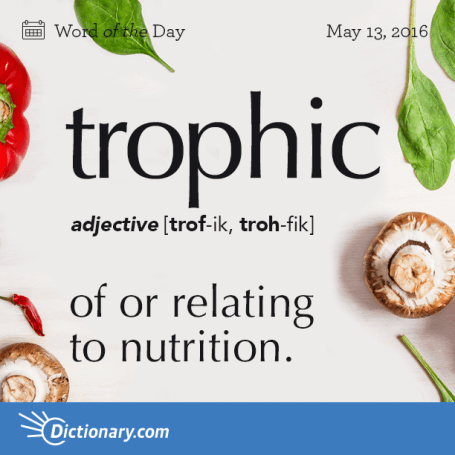
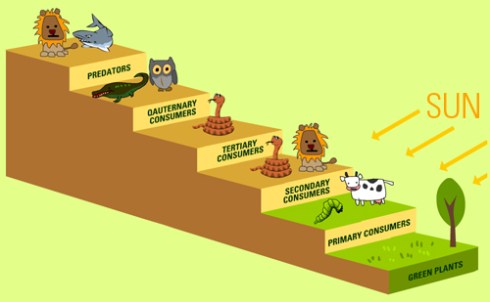
Happy Friday! Today’s Dictionary.com Word of the Day is Trophic. I don’t think I have ever heard this word before. Though I am familiar with trophic levels as they relate to the steps in the food chain. So it is likely that may have seen it in the course of my biology studies. At any rate, it is an adjective.

The Oxford Dictionary defines Trophic as:
1
Relating to feeding and nutrition.

1.1Physiology (Of a hormone or its effect) stimulating the activity of another endocrinegland.

Origin
Late 19th century: from Greek trophikos, from trophē ‘nourishment’, from trephein ‘nourish’.

The definition above tests the limits of my left brain! When I set about to research the word, the term, trophic “levels” kept coming up, complete with PICTURES. Now THIS, I can wrap my right-skewed brain around. Thank goodness! Or I might never have been able to wrangle a haiku out of the word. I give you then… Trophic in Haiku…with pictures. 🙂

food-chain-levels

Breaking the Food Chain

Human consumers
top food chain trophic levels
unless they’re vegan.

kat ~ 13 May 2016


Turpitude – Friday’s Word of the Day Haiku


Happy Friday! Today’s Dictionary.com Word of the Day is Turpitude. It finds its roots in the Latin term turpis meaning “base, vile”, entering English in the late 1400’s. Today, it is often paired with the word, “moral”. (See below)Happy Friday! Today’s Dictionary.com Word of the Day is Turpitude. It finds its roots in the Latin term turpis meaning “base, vile”, entering English in the late 1400’s. Today, it is often paired with the word, “moral”. (See below)

From Wikipedia:

Moral turpitude is a legal concept in the United States and some other countries that refers to “conduct that is considered contrary to community standards of justice, honesty or good morals. This term appears in U.S. immigration lawbeginning in the 19th century.

The concept of “moral turpitude” might escape precise definition, but it has been described as an “act of baseness, vileness, or depravity in the private and social duties which a man owes to his fellowmen, or to society in general, contrary to the accepted and customary rule of right and duty between man and man.”

Perpetrators of turpitude can be found, of course, filling our prisons, but I can think of a few other places where they might hang out! Here is my haiku then. Have a great weekend! 

Some fill our prisons,
Those guilty of turpitude,
Some are elected!

kat ~ 6 May 2016