Category Archives: Word of the Day Haiku

Stravage – Friday’s Word of the Day Haiku

stravage

Happy Friday. Today’s Dictionary.com Word of the Day is Stravage.

Originally entering the English language in the late 18th century this Scottish/Irish word is derived from an aphetic contraction, which means that it is a word formed by combining two words as well as by aphesis (the loss of an unstressed vowel at the beginning of a word (e.g., of a from around to form round ).

From Medieval Latin we have ‘extravigari’ which means to wander out of bounds, digress or ramble. ‘Vagare’ is an Italian intransitive verb that means: to wander aroundroam around, to roam. I particularly like this Italian phrase: “vagare con la fantasia” which means to give free rein to one’s imaginationlet one’s imagination run away with one.

And to round out the etymology of this most interesting word, the Italian verb ‘vagare’ or ‘vargari’ is derived from the adjective ‘vagus’ which means strolling or unsettled and is thought to be a precursor of the English word ‘vagrant’. Back to our word, stravage. To get to its current form, the “ex” from the original Latin ‘extravigari’ was dropped by the Scots who converted the word to ‘stravaig’. It was later embraced by the English, dropping the ‘i’and adding an ‘e’.

I was able to find a delightful, award-winning Glasgow restaurant called Stravaigin in my stravaging across the internet. True to its name, their website’s “About” page links us back to this 18th century word: “‘Stravaig’ meaning ‘to wander’ encompasses our ‘Think Global, Eat Local’ ethos perfectly. So wander off the beaten path into either the street level cafe bar or the downstairs restaurant where you’ll find menus showcasing Scottish produce that isn’t tethered to its roots. Awarded the Michelin Bib Gourmand every year since 2012.” Stravaigin is quite modern however, offering local fare with an exotic flare. Click on the link of their name above to check them out. If ever you’re in Glasgow…;)

The Scots, I have learned, are very proud of their native language and heritage. There is an entire website devoted to all thing Scots…but I suppose I am digressing…or stravaging you might say. Since I am descended from Scottish ancestors, this will be on my to-do list for future study. 🙂

I am quite fond of stravaging. I admit that I do it often! Those who know me are able to recognize my stravaging ways immediately. I am told my eyes glaze over and I may start humming a tune to myself, which drives people batty. But in my mind, I am having a jolly good time taking it all in. The scenery that is. I am not so worried about the destinations in life that I do not pay good mind to the journey. The journey after all is where it’s at. (whatever “it” may be) I have a tin plaque in my room that says, “I never worry when I get lost, I just change where I want to go.” A friend got it for me. Stravage is a good word of the day for me. Fits me to a “t”. Have a great Friday!

to those who stravage
some may think you’re a lost fool
 but you are seeking 

to be an artist
it helps to be an odd bird
with stravaging wit

delicate ivy
stravages up walls, clinging
destruction’s embrace

~kat – 10 March 2017


Hydra – Friday’s Word of the Day Haiku

hydra

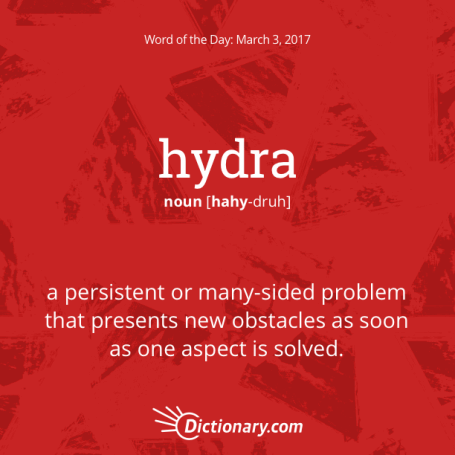
Happy Friday! Today’s Word of the Day on Dictionary.com is “Hydra”. At first glance I assumed that it probably had something to do with water; at least that is what I thought, based on its similarity to its cousin “hydro”.  But as I have discovered time and again, every word and its origin is many splendored and complex thing!

Dictionary.com defines Hydra as a “persistent or many-sided problem that presents new obstacles as soon as one aspect is solved.” It cites its first use in English literature by the great Geoffrey Chaucer (c1340-c1400) which is where things get interesting because Chaucer’s reference is derived from the Middle French ydre which is derived from the Latin hydra which is borrowed from the Greek hydra which means “water-serpent”, and is closely related to the Greek Hydor for “water” which comes from the Proto-Indo-European root words…wed, wod, and ud meaning “wet water” which is the same as the German root, which is linked to the the Slavic (Czech) root voda for “water” or ‘vodka”…which is also linked to the Old Irish root uisce for “water” bringing us to the full circle back to the English language the links Hydra’s origins to the word “whiskey”. I could use a drink right about now! What does this word mean exactly? Please refer to the definition the photo above. Okay…I get it…I think…maybe not. Clearly this word has been around for a long, long time giving it many opportunities to morph from culture to culture and from ancient to modern.

A side thought…I absolutely love this simple little 5 letter word because it is a great word for us Scrabble or Words with Friends fans. It makes use of that pesky, high dollar (point) “Y” in the middle of a word that is short enough that you might actually have a bingo on the board. Well not exactly a bingo, because you can only have a bingo on a bingo board…but you get my drift.

A quick jaunt on the Google express brought me to Wikipedia which splintered off in a myriad of directions in reference to this word. Here are a few highlights:

Hydra is a winner of a word with a myriad of meanings associated with it…as numerous as, perhaps, the many heads of a serpentine water monster from Greek and Roman mythology that goes by the name Hydra? Um yep…that’s the one. In mythology the Hydra’s lair is on the lake of Lerna and it was also reputed to be an entrance to the Underworld with “poisonous breath and blood so virulent that even its scent was deadly!” Eventually the Hydra was killed by Hercules, but not before he discovered that each time he cut off one of its heads, two more would grow in its place! His skillful use of the sword, followed by a quick cauterizing of the neck stubs with fire, are what finally killed the beast in the end.

Then of course there are the smaller versions of this monster, a genus of tiny freshwater animals that are tubular in shape with tentacles and a leech-like mouth. These Hydras have fascinated scientists for years because they are asexual little beasts who can regenerate their parts if injured and who also do not appear to age or die of old age. One scientist by the name of Daniel Martinez even made the claim in a 1998 article that Hydra are biologically immortal! I’ll have what they’re having…a healthy helping of plankton and unicellular algae, thank you very much…or maybe not…:P

A look to the sky gives us another view of Hydra the constellation. Discovered in the 2nd century by astronomer Ptolemy, it is represented as a “water snake” and is the largest of modern constellations; its close neighbors include Libra, Centaurus and Cancer.

Hydra is also the name of the outermost, odd shaped, water ice moon of Pluto (formerly known as the Planet Pluto).

And then there is what seems to be a never-ending list of Hydras that range from Brands and company names to people, places, pop culture, sports and technology. (See the entire list HERE)

Of course I could go on…but I won’t. It’s Friday after all and the weekend is calling my name! Have a good one yourself.

Might be a hydra
if one thinks a problem’s solved
beware of the glitch

~kat – 3 March 2017


Scapegrace – Friday’s Word of the Day Haiku

scapegrace

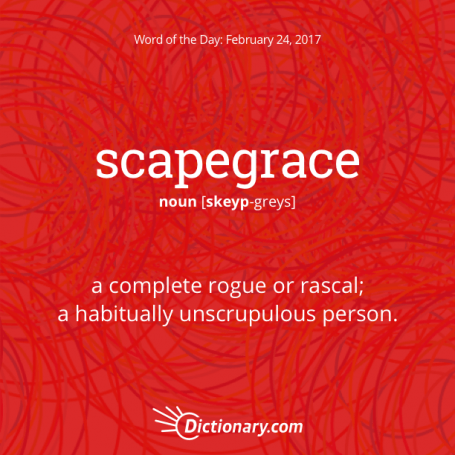
Happy Friday! Today’s Word of the Day from Dictionary.com is “Scapegrace”. When I first saw it, I thought of the common term scapegoat, but this word has very little to do with scapegrace, unless of course you are talking about the poor sap who finds himself in the company of a scapegrace; blamed for the unscrupulous deeds of their grace-less scoundrel of a friend! Then the two fit together, albeit uncomfortably, like two peas in a pod.

Scapegrace is defined by various online dictionaries as a complete rogue or rascal; a habitually unscrupulous person; scamp; a reckless and unprincipled reprobate; or a kinder definition states, “A man or boy of reckless and disorderly habits; an incorrigible scamp. Often used playfully.” A common synonym for the word is “black sheep”. You get the picture. You likely have a picture in your mind right now of a particular scapegrace you might know. (not going to mention any names here 😉 )

The word entered the English language in the mid 18th to early 19th century, over 200 years after the word “scapegoat” came into play, which is rather ironic in retrospect. It took two centuries for scapegrace to become a word, leaving poor old scapegoat to face the music alone. One wonders if it was just hiding all those years.

Scapegrace is made up of the verb “scape” which is a variant of “escape” and the noun “grace”, which literally means “one who escapes or flees the grace of God.”

Oh, and there is one other obscure meaning associated with the word. Scapegrace, in ornithological (the branch of zoology that deals with birds) circles, can also refer to a red-throated loon or diver. Like other loons scapegrace loons are primarily fish eaters and monogamous. Their red throat comes into play during mating rituals. They are not particularly graceful on land due to the positioning of their legs toward their back ends. In fact, the word loon is thought to be derived from the Swedish “lom” which means “lame” or “clumsy”, but this is said to give them great mobility and thrust in and under water. They are excellent swimmers taking to the water only days after hatching.

They are also associated with the creation mythology of indigenous peoples, given the name “earth-diver” in one such story. As legend goes, the Red-Throated Diver was asked by a great shaman to bring up the earth from the bottom of the sea. This is how the world’s dry land was formed.

Through the years the loon was also used as a weather predictor. Move over Mr. Ground Hog! Depending on the location, some people believed it would be fair or rainy based on the direction of the scapegrace’s flight (inland – nice weather or out to sea – not so nice). Other communities relied on its various calls to determine the weather; a gaa-gaa-gaa or turkatrae-turkatrae meant nice weather, whereas meowing like a cat was a sure prediction of rain. With few predators the oldest known Red-Throated Loon, found in Sweden, lived to be about 23 years.

So there you have it, a glimpse into another odd word that we rarely use these days with an avian link associated with its meaning. I’m beginning to see a trend here! What to do, what to do with this week’s Haiku…scapegoats, but not scapegoats and scapegraces and loons…

If you’re a scapegoat
you likely know a scapegrace
who is a bad egg!

~kat – 24 February 2017

Have a great weekend!


Oscitant – Friday’s Word of the Day Haiku

oscitant.png

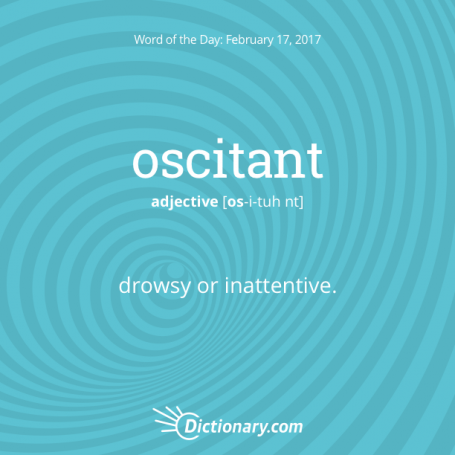
Today’s Dictionary.com word of the day is “oscitant. It’s a rather matter-of-fact word, with little backstory or legend to be found in its etymology. I suppose we need a few to the point with no detour words so we don’t get completely confused. According to Dictionary.com oscitant is defined as:

1-drowsy or inattentive.
2-yawning, as with drowsiness; gaping.
3-dull, lazy, or negligent.

It originates from the Latin verb ōscitāre which means “to yawn, gape (of animals); “to turn toward the sun (of plants”; and by the extension “to be listless, drowsy, inactive, half asleep.” It entered the English language in the early 17th century.

“Surely there is something interesting to report on this word,” you might be thinking. But nope. What you see is pretty much what you get. Much like its definition, it is rather boring, yawn-inducing…oscitant in fact.

But I did become intrigued with a word very much related to oscitant. It is word yawn. Here are a few fun facts regarding yawns.

  • Commonly associated with tiredness, stress, sleepiness or even boredom and hunger, a yawn is in fact thought to have more to do with the cooling of one’s brain. (Who knew?!)
  • Yawning consists of the simultaneous inhalation of air and the stretching of the eardrums, followed by an exhalation of breath.
  • In some cultures yawning is considered an action that has spiritual significance. In this case an open mouth is associated with letting one’s soul out or allowing evil spirits in. It is believed that this may be why we have been trained to cover our mouths when we yawn, so as not to be vulnerable to losing one’s soul or becoming possessed by a demon!
  • Yawning “loudly” is considered the height of rudeness and in former societies could even lead to contempt of court charges.
  • Contagious Yawning is a real thing seen in humans and animals as an empathetic response or positive feedback.
  • Contagious Yawning may also be an instinctual herd instinct that has kept animals alert giving them an evolutionary advantage.
  • In primates, a yawn is a threat gesture and a way of maintaining social structure.
  • Humans can pass a contagious yawn to dogs.
  • Excessive yawning can be a symptom of disease such as multiple sclerosis or brain stem ischaemic stroke, particularly as they are related to neurological pathways and cortisol levels.
  • Other reasons why animals yawn include: Yawning as a part of courtship rituals (the ecstatic display of certain types of penguins), as a display of dominance or anger (as is the case for baboons, Siamese Fighting fish, guinea pigs), to realign their jaws after a meal (as demonstrated by snakes) and for respiratory reasons (fish in general due to a lack of oxygen).

Even when a word “is what it is”, leave it to me, I’ll find a way of making it interesting! 🙂

Have a great weekend! Here’s my Haiku.

Oscitant Haiku

a speaker’s nightmare,
more than forgetting one’s speech,
an oscitant crowd

kat ~17 February 2017


Whiffler – Friday’s Word of the Day Haiku

whiffler.png

Happy Friday! Today’s Dictionary.com Word of the Day is “Whiffler”. The pop up meme for today’s word defines whiffler as “a person who frequently shifts opinions, attitudes, interests, etc. You know, your basis politician!

But as is the case with most words, there is more to the story. Oh yeah, there definitely is. A quick survey of other dictionaries revealed a few more facets to this fun to say word.

Whiffler Definitions
Webster’s Revised Unabridged Dictionary

  1. Whiffler An officer who went before procession to clear the way by blowing a horn, or otherwise; hence, any person who marched at the head of a procession; a harbinger.”Which like a mighty whiffler ‘fore the king,
    Seems to prepare his way.”
  2. Whiffler One who plays on a whiffle; a fifer or piper.
  3. Whiffler One who whiffles, or frequently changes his opinion or course; one who uses shifts and evasions in argument; hence, a trifler.”Every whiffler in a laced coat who frequents the chocolate house shall talk of the constitution.”
  4. Whiffler(Zoöl) The golden-eye.

Century Dictionary and Cyclopedia

  1. n-whiffler A piper or fifer.
  2. n-whiffler A herald or usher; a person who leads the way, or prepares the way, for another: probably so called because the pipers (see piper,1) usually led the procession.
  3. n-whiffler One who whiffles; one who changes frequently his opinion or course; one who uses shifts and evasions in argument; a fickle or unsteady person.
  4. n-whiffler A puffer of tobacco; a whiffer.
  5. n-whiffler The whistlewing, or goldeneye duck.

I discovered that there are two different references relating to the origin of the word, depending on the definition applied. First, around 1530-40, a whiffler was defined as an armed attendant who cleared the way for a procession derived from the Old English wifle or wifel for spear or  battle-ax. Later, between 1600 – 1610 the moniker ‘Whiffler’ was applied to a person who frequently shifts opinions, vacillates or is evasive in an argument. Somewhere in the time between these two definitions, some suggest because whifflers who wielded flags or spears stirred up “whiffles of wind”, whiffle came to be defined  as  wind that blows in puffs or slight gusts, or veered or shifted about. This may explain how the definition morphed from armed attendant to bloviating bag of wind (aka one who is shifty or evasive, or a trifler), but there is more to the story of this word. It is also used synonymously with the word piper, as in one who plays a fife. Still more wind references.

I also happened upon the recollection of 20th century Thomas Ratcliffe, a contributor to Notes and Queries who wrote about the “art of the Whiffle-Waffler”. It was apparently a common art, or sport as I would call it, where boys and men would twirl sticks with their hands, around their bodies and heads, behind their backs, under their thighs and high up in the air, catching them with great precision. Uh…sounds a bit like baton twirling to me. 🙂 Apparently it was a classy “thing” back in the day and an art practiced exclusively by men. At any rate, the “art” of whiffle-waffling apparently died out in the mid 19th century. There is a sad story penned by George Borrow in his work The Romany Rye in 1857 that states, “The last of the whifflers hanged himself about a fortnight ago … from pure grief that there was no further demand for the exhibition of his art, there being no demand for whiffling since the discontinuance of Guildhall banquets.” 

The article I read on the topic also encouraged one to imagine the drum major or field commander of a marching band who leads with a baton or military mace. While not directly related, the author suggested that we can imagine the two side by side, an armed attendant leading a royal entourage and a baton wielding band leader leading a drum corps.

So there you have it. Whiffler and its many iterations and applications over the years…except for just one teeny, tiny, little thing. There’s more.

Whiffler can also be another name for the Goldeneye long-tailed duck or Whistlewing, so called because of the whistling sound that it makes when it flies. Ok…related to the wind…that fits. But what does a duck have to do with the original Dictionary.com definition? Except maybe to say… “If it looks like a duck, swims like a duck, and quacks like a duck, then it is probably a duck.”

I better just get to my haiku’s (I have two of them for you today)…and wish you a happy weekend!

Whifflers

A shifty whiffler
spinning alternative facts
loves gullible fools

Some whifflers whiffle
while some others may waffle
unless they’re a duck

kat – 10 February 2017