Category Archives: Word of the Day Haiku

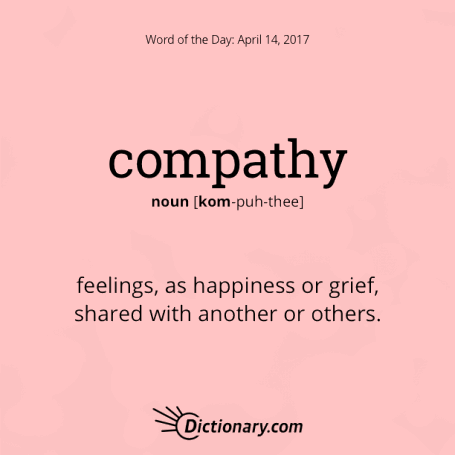
Compathy – Friday’s Word of the Day Haiku

compathy.png

Happy Friday! Well here is a new word for you…”Compathy”, Dictionary.com’s Word of the Day. It is another word to add to your arsenal of “feeling” words like Sympathy and Empathy, but with just enough of a subtle difference that you may find yourself needing to use it more and more.  The suffix of all three words is –pathy from the Greek ‘patheia’ which means ‘suffering’ or ‘feeling’.

Sympathy’s prefix, sym- comes from the Greek sum or sún, meaning “with, in company with or together with.” While feelings are part of the word, it is possible to be sympathetic without actually feeling what others are feeling. For example one could be sympathetic to a cause. One who is sympathetic might be overheard saying, “Oh poor so-and-so…” and in the next breath commenting, “I’m sure glad it’s not me.” So much for sympathy. No wonder  we are loath to sympathy from others. It smacks of pity.

Enter Empathy. From the Greek ‘empatheia’, when one combines em + pathy the literal meaning is ‘in’ + ‘feeling’.  It’s a feel good word…much more to our liking than sympathy. Having empathy is the ability to put yourself in someone else’s shoes; to consider their plight while also considering how you might feel in the same circumstance. It’s a bit more engaging. Being empathetic moves us emotionally and compels us to act with compassion, but it is not the ultimate of –pathies. One can remain detached more or less and still feel and respond with empathy.

Which brings me to today’s word of the day, Compathy. It’s little prefix of a word, ‘com’ is a loaded when you add it to -pathy.  For this word’s etymology we turn to the Latin ‘com-‘ or ‘cum’ which means “together with, similar, extremely, completely.”  Compathy contains an intensity that the other two words do not.  Compathy is defined as “feelings, as happiness or grief, shared with another or others.” There is no detachment here, no standing on the sidelines. To have compathy means to feel the intense emotions of another with that other person or persons as if you share the same heart.

I can understand why compathy is more obscure than the other two words. Have you ever heard of it? I know I hadn’t.  And my ignorance allowed me to be quite content, considering myself a caring, feeling, empathetic person…which is a good thing, right? The fact is my ability to care has now been challenged to rise to the next level; to allow myself to enter into the suffering and joy of others whole heartedly and with abandon.

We call a person who acts and feels this way an “empath”, but I believe we have it wrong. Empaths are truly Compaths when you get right down to it. And it’s something to aspire to. Not because I’m a masochist but because I believe having compathy is the one true way to connect with another person in a deep and meaningful way. It’s where love and healing and true joy happen.

Have a great weekend. Peace and love to you and yours.

sympaths say “poor you”
empaths say “poor you, I know…”
but compaths say “we”

~kat – 14 April 2017


Inveterate – Friday’s Word of the Day Haiku

inveterate.png

It’s Friday. Thank goodness it’s Friday! Today’s dictionary.com Word of the Day  is “Inveterate”. It is defined as: settled or confirmed in a habit, practice,  feeling, or the like: an inveterate gambler; firmly established by long continuance, as a disease, habit, practice, feeling, etc.; chronic.The Collins Dictionary also adds an obsolete meaning: full of hatred; hostile.

Dictionary.com gives us a nice bit of history on the word:
Inveterate comes from the Latin verb inveterāre “to grow old,” a derivative of the adjective vet(us) “old.” Latin vet- is related to Greek ét-os (Doricwét os) “year” with its derivative etḗsios “yearly” (cf. “etesian winds”). The Latin nouns vitellus and vitulus “calf, bull calf, yearling” are also derivatives of vet(us). The Latin name for Italy, Italia, has the rare form Vitalia (cf. Oscan Víteliú), both of which are from Greek italós (Doricwitalós) “bull,” because Italy was rich in cattle. Inveterate entered English in the 16th century.

There is not much in the way of backstory that I could find for this word apart from its peculiar etymological link to cattle; bulls in particular. If you ask me, there are quite a few derivatives in the above blurb, which makes me a bit suspect. But for the sake of discussion I can probably squeeze some sort of relevance out of all this. For example, bulls are generally seen as stubborn, immovable, etc. Not exactly following the “because Italy was rich in cattle” part. Um, okay…if you say so…that’s nice to know…not.

As for the “growing old” part, it is true that some old people are set in their ways. Routine and habit are comforting ruts for some. But I would venture a guess that not all elder folk are inveterate; some are quite comfortable with movement and change (including me. And I do qualify as a first person expert. I have my AARP card to prove it!). But that’s about all I could muster on this week’s word. It is what it is. As with all bland, so-so words, use em or lose em.

I did discover that as a ten letter word, inveterate will land you a whopping 63 points in Scrabble. Good luck with that. I am lucky when I can use all SEVEN of my allotted letters, let alone TEN! But you can store that in the “obscure word fact” file in your brain. Never know when you might need it.

Have a great weekend!

Signed,
An Inveterate Optimist 🙂

Truth is elusive
to inveterate liars
fiction is the truth

~kat – 7 April 2017


Weltschmertz – Friday’s Word of the Day Haiku


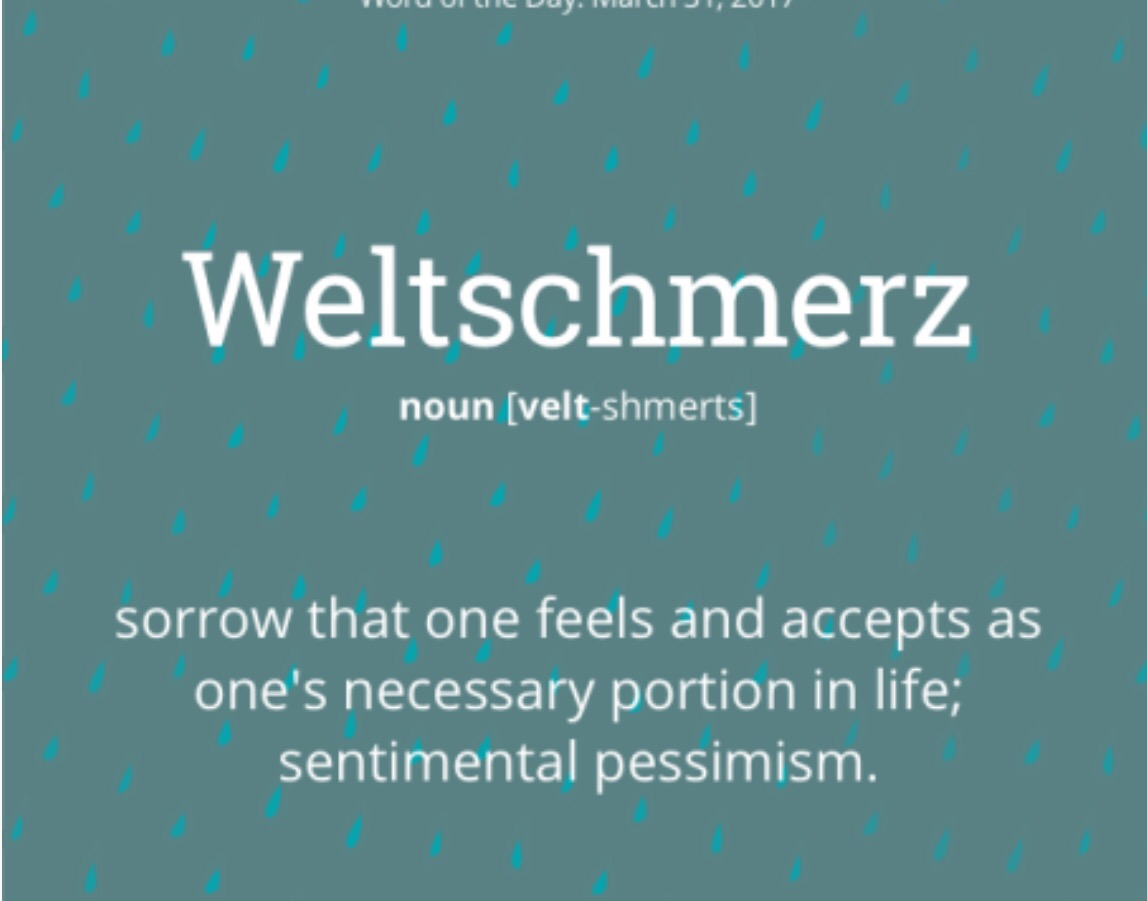
It’s Friday in most parts of the world right now. I was going to say as I usually do, “Happy Friday” but I can’t assume to know if it is happy where you are. I’m not even sure if I am happy in this moment. Content maybe, but happy? Happiness takes effort. Which brings me to today’s dictionary.com Word of the Day, Weltschmerz. Leave it to the Germans to fashion a word that captures the day in day out ruts that we find ourselves languishing in.

Do you ever wonder if this is all there is? Weltschmerz is “the sorrow that one feels and accepts as one’s necessary portion in life.”

It is also defined as “sentimental pessimism”. As you can imagine, many a writer has penned this word.

Weltschmerz (the w sounds like a “v”) even sounds resigned to a certain apathetic resolve. It is what it is…weltschmerz. It’s a combination word that means “world” (welt) and “pain” (schmerz) first appearing in the 19th century by German Romaric Writer Jean Paul, pen name of Jean Paul Friedrich Richter (1763-1825), in his novel Selina (1827). But it also found its way into English 50 years later and into modern literature by such authors as John Steinbeck, Kurt Vonnegut, Ralph Ellison and Henry Miller.

In researching this word it was described as “obscure German sorrow”, which led me down another wormhole to discover a modern English version of this concept.

Created and written by graphic designer and editor John Koenig, the Dictionary of Obscure Sorrows is a melancholic writer’s treasure trove of newly created “feeling” words. It’s an amazing collection. If you want to explore more check out his blog here or better yet check out his YouTube entries; beautiful narrations set to music and photos that illustrate these new words.

Back to weltschmerz and my task for today…to write a Haiku poem. While I can’t presume to know if your day is happy at the very least I can wish you happiness in this crazy spinning world. I hope you have a happy weekend too. 😊

moments slip away
mindlessly lost in weltschmertz
no seizing the day

~kat – 31 March 2017


Esoterica – Friday’s Word of the Day Haiku

esoterica.png

Happy Friday. Today’s Dictionary.com word of the day is Esoterica. But I couldn’t resist the word of the day for yesterday…Throttlebottom (Definition: a harmless incompetent in public office.)! What an awesome word. Oh how I wish we used these types of words today. How enjoyable the nightly news would be if our journalists embraced some of the other obscure, descriptive words featured as words of the day. I wish I had time to research each one. Here’s a sampling of the last week or so…

Breaking news from kat’s imagination: “Today was a most cimmerian day for the nation. The halls of congress were a-twitter with crocodilian calls for justice in response to the latest canard from our vaunting, throttlebottom of a president. Meanwhile the lotus-eaters were oscitant to this developing malfeasance.”

Even if the news is bad, at least it would be entertaining.

But back to our official word of the day, Esoterica. It is a noun that evolved from the Greek adjective esōterikós which means “belonging to the initiate, inner, esoteric” with a “distinguished history in ancient Greek philosophical systems (Pythagorian, Aristotelian, Stoic).” The English noun form is attributed to poet Ogden Nash who used the term in a 1930’s poem published in The New Yorker, referring to the obscenity trials over James Joyce’s Ulysses. It is defined as things understood  by or meant for a select few; recondite  matters or items.  Or curiosa (books,  pamphlets,  etc.,  dealing with unusual subjects, including books, pamphlets, etc., containing pornographic  literature or art; erotica).

I like this quote from Lemony Snicket’s A Series of Unfortunate Events, “Life is a conundrum of esoterica”.  It literally means that life is a confusing and difficult problem, question or riddle, understood by or meant to be understood by a select few. I think it captures the meaning of esoterica perfectly!

Unless of course it is a skin cream. Esoterica the moisturizer promises to lighten dark (brownish) areas on the skin, such as freckles, age and liver spots and other skin conditions that result in localized high concentrations of melanin.

Or a Black/Heavy Metal music band called Esoterica from Pennsylvania…or the now disbanded UK Christian rap/West Coast hip-hop, Dance/Electric band called ESO for esOterica…or the name of a secret cult of humanoid characters, with access to alien technology, able to span dimensions, called the The Flame Keepers’ Circle in the gaming world’s story of Diagon. But I digress. 🙂

My job today is to come up with a haiku using today’s word of the day…Esoterica. Skin creams, Metal/Alertnative/Rock bands and video cult circles aside, I am mulling around the idea of applying estoterica to the current secretive nature of our government. With the added bonus of yesterday’s word, throttlebottom, you get a two-fer this week. Have a great weekend!

daft throttlebottoms
bellow esoterica
proving they are fools

kat ~ 24 March 2017


Smaragdine – Friday’s Word of the Day Haiku

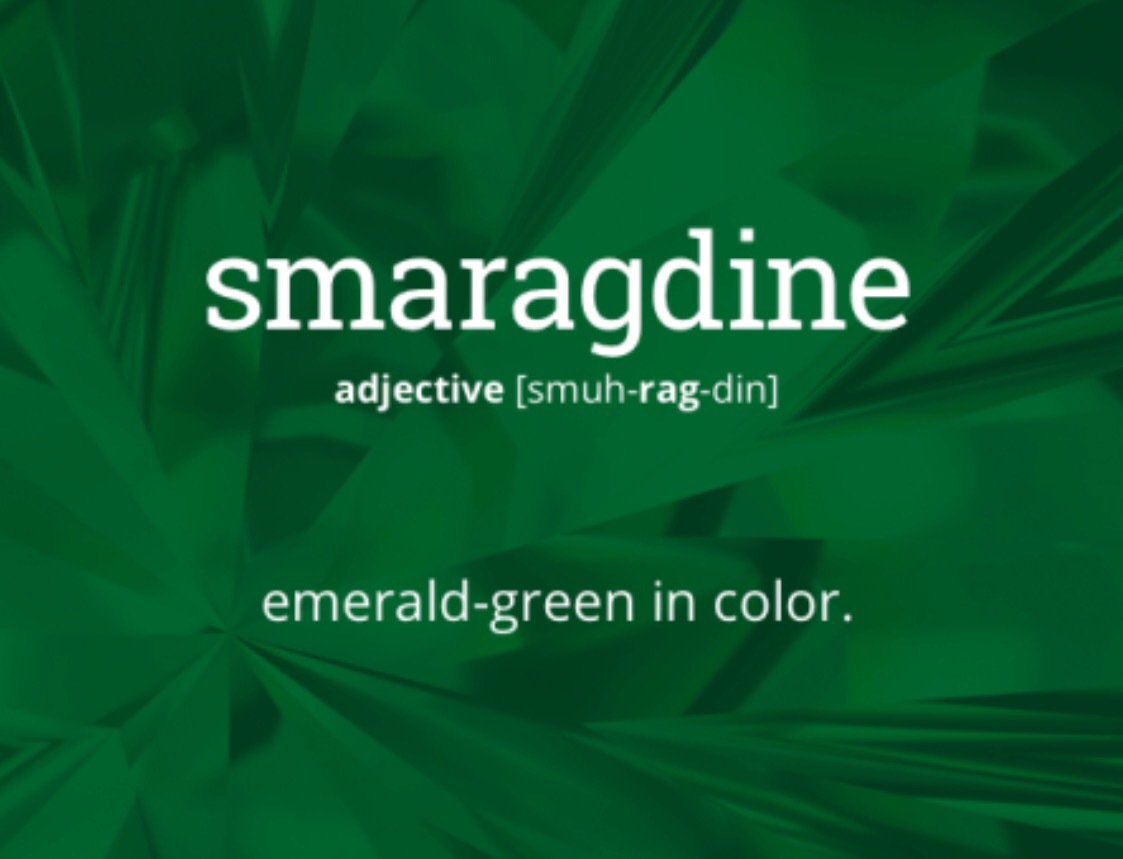
Happy Friday. And Happy St. Patrick’s Day! Dictionary.com‘s perfect word for today is Smaragdine, which means of or relating to emeralds; emerald-green in color. Perfect right? It’s originated around 1350–1400 from the Middle English word smaragd that literally means “emerald” as well as Latin smaragdīnus and Greek smarágdinos, which are equivalent to smáragd(os).

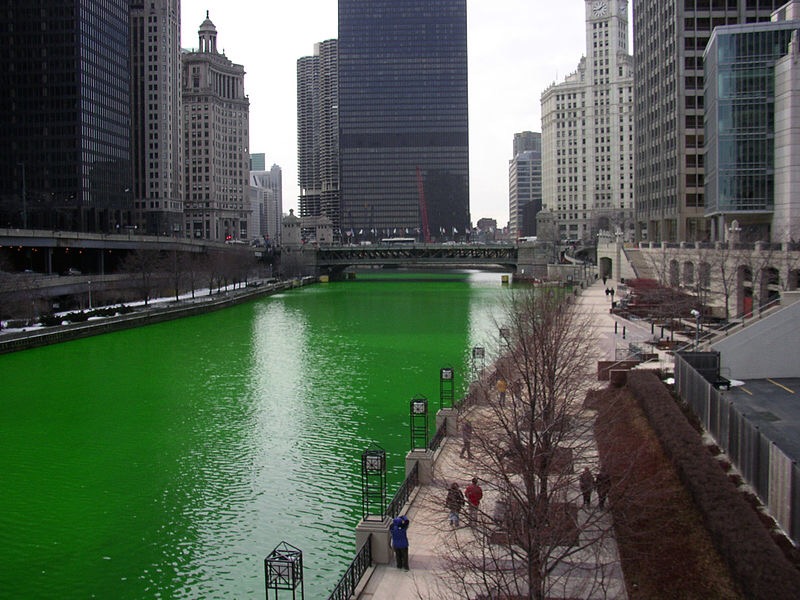
Of course on a day like today I naturally think of my Irish heritage and my Chicago roots where the river through the city runs green every year. Here’s a little history about the river that I found on Wikipedia:

The tradition of dyeing the river green arose by accident when plumbers used fluorescein dye to trace sources of illegal pollution discharges. The dyeing of the river is still sponsored by the local plumbers union.

The United States Environmental Protection Agency (EPA) outlawed the use of fluorescein for this purpose, since it was shown to be harmful to the river. The parade committee has since switched to a mix involving forty pounds of powdered vegetable dye. Though the committee closely guards the exact formula, they insist that it has been tested and verified safe for the environment. Furthermore, since the environmental organization Friends of the Chicago River believes the dye is probably not harmful, they do not oppose the practice.


In 2009 First Lady Michelle Obama, a Chicago native, requested that the White House fountains be dyed green to celebrate St. Patrick’s Day.

Clearly that smaragdine river leaves quite an impression on us Chicago daughters!

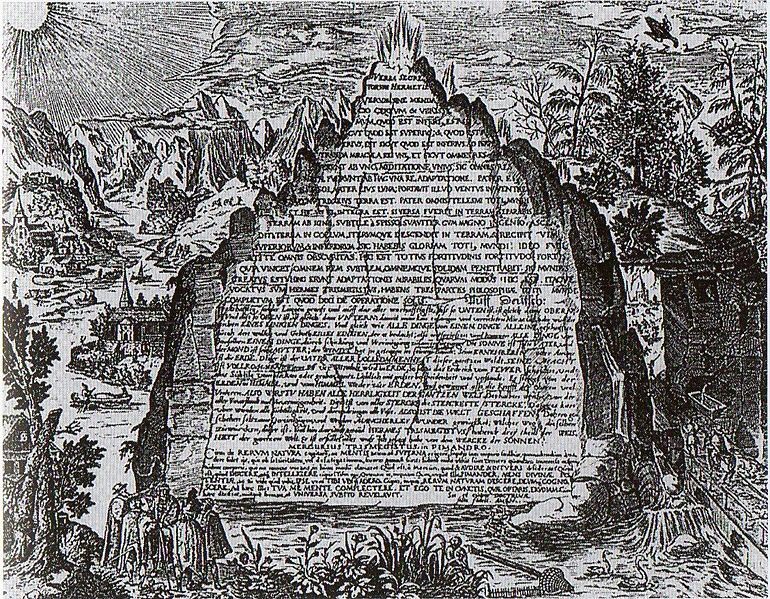
An imaginative 17th century depiction of the Emerald Tablet from the work of Heinrich Khunrath, 1606.


I found one more cool reference to the word. It has to do with an ancient cryptic piece Hermetic lore called the the Smaragdine Tablet. It’s origin is a point of debate, with some scholars who believe it to be 1200 years old and others who claim that it is over 38,000 years old, chiseled into a smaragdine tablet by the gods. It has been associated with the philosopher’s stone, laboratory experimentation, phase transition, the alchemy and magic.

There is even a reference from the tablet in the Gnostic Gospels of Phillip and Thomas in the text “above and below” as much as “inside and outside.” You can read more HERE.

And there is even a modern reference to the tablet in the 2006 miniseries, “The Curse of King Tut’s Tomb”. If you have several hours to kill, you can spend some time researching this tablet. It’s definitely an interesting read if you like a good mystery.


Which brings me back to Chicago and the green river and St. Paddy’s Day. Trust me it does….take me back, that is. When I was a girl I always believed that it was the magic of leprechauns who turned the river green.

We all need a bit of magic and mystery every now and again so we don’t take ourselves and the crazy realities of the world too seriously. I think I understand why Mrs. Obama asked for that green fountain on March 17th. I find myself googling Chicago every year to see the green river. As crazy weird and mysterious as it is, it gives me comfort and memories of home…and of course Spring! 

Sláinte ~ kat

smaragdine rivers,
stones etched mysteriously
greening is magic

kat – 17 March 2017